.svg)

.svg)


.svg)

.svg)


.svg)


%201.svg)
.svg)


%201.svg)
%20(1)%201.svg)
.svg)


.svg)
%201.svg)

Over the past two years, we’ve been closely watching how the broader blockchain landscape was evolving. Today, we’re sharing where we stand, what we’ve decided, and what’s coming next for the network.
Today’s blockchain landscape situation
Back in 2019, when Fuse launched as one of the first sidechains, the conversation in crypto was dominated by NFTs, gaming, and Ethereum killers. The idea that blockchains would become a real alternative to fiat in everyday life was a hard sell. Stablecoins hadn’t yet had their baptism by fire. The L1/L2 framework barely existed. And yet that was exactly the thesis we were building toward.
Today, the entire world is sold on that vision.
The infrastructure boom last cycle played out differently than anyone expected: more chains than users, consumer adoption slower than projected, institutional demand flowing through traditional rails. But underneath that noise, the important things happened: regulation caught up, infrastructure matured, and the bottlenecks that held back the previous cycle are largely gone. The environment Fuse was designed for is finally here.
The rest of the industry is arriving at the same conclusion. Projects that became effectively L2s last cycle, Polygon, Starknet, and others, are reversing course. New entrants like Plasma and Arc are starting from the same premise we had in 2019. And the L1/L2 distinction itself is collapsing: sovereign chains, whether technically L1 or L2, are going to look the same in the long run. Execution, ownership, and economics will converge. We saw this coming.
We’ll be honest: we took our eye off the L1 for a while. That changes now. The conviction is back, stronger, and backed by new insights that genuinely excite us about what Fuse can become. AI agents are becoming economic actors. The next wave of on-chain activity won’t be driven by humans clicking through apps. It will be autonomous agents transacting, hiring, and settling work programmatically. Standards like ERC-8183 are being built to make that possible. Fuse is built to support this demand.
Agentic Payments: Fuse as the Settlement Layer
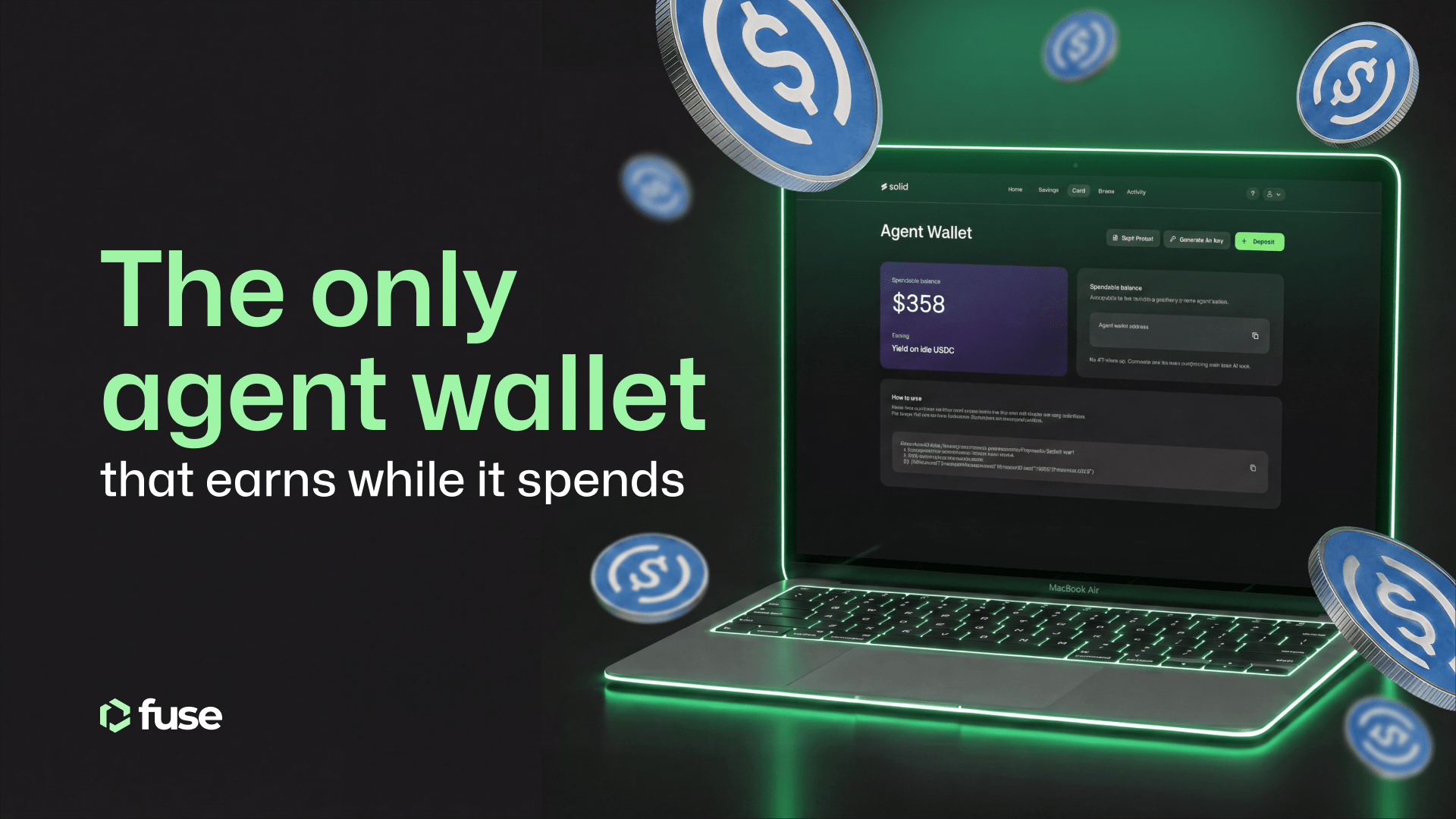
Agentic payments are no longer theoretical. New open standards are giving AI agents the ability to transact autonomously: x402 for HTTP-native micropayments, MPP by Stripe and Tempo for machine-to-machine commerce, and UCP by Shopify and Google as a universal commerce protocol. The reason these run on blockchain is simple: AI agents can’t open bank accounts, hold cards, or satisfy KYC requirements. They can own a wallet. And stablecoin rails settle transactions for fractions of a cent in under 200ms, making micropayment-scale commerce economically viable in a way traditional rails never could.
Beyond these three, ACP (Stripe and OpenAI) is emerging as the checkout layer inside AI interfaces, and AP2 (Google) covers enterprise-grade authorization with auditable trails. These aren’t competing to be the only standard; they’ll coexist across different layers of the stack.
Our thesis is that agentic payments and dedicated merchant blockchains are a match made in heaven. These protocols are being built for the top of the market, for enterprises, platforms, and developers with the resources to integrate them. But the bigger opportunity is the long tail: the small and medium businesses that move the most economic value globally and have always been priced out of serious payment infrastructure. A last-mile solution they actually own, with no million-dollar integration fees, no middlemen taking a cut, and no dependency on Stripe having a product that fits their market.
That’s the playing field Fuse is built to level.
We’re integrating native support for these protocols across Fuse Chain, the developer stack, and Solid so any agent, app, or AI tool built on Fuse can settle payments, trigger loyalty rewards, and move money across borders without a bank account, a Stripe account, or a Shopify plan. A dedicated Fuse MCP server is in development, alongside deeper integration with the agentic payment standards gaining traction across the industry. More details to follow as we ship.
Alongside this roadmap, we’ve launched a new Fuse website to reflect where the network is headed — the infrastructure thesis, the agentic payments vision, and the full stack from Fuse Chain to Solid.
Solid: Fuse’s Killer App 📈
Solid is our answer to the “why does this chain matter” question, and our first serious consumer-first product.
Think of it as a DeFi mullet: traditional finance UX on the outside, DeFi infrastructure underneath. Stablecoin yield, a Visa debit card, and borrowing tools, vertically integrated on Fuse, accessible to anyone with a phone.
But the vision goes beyond yield. We want Solid to be where you live financially. Earn on your savings, spend with your card, pay your bills, split payments with friends. No reason to ever open another app. Your wallet is your bank account, and with the power of smart contracts it’s borderless, unstoppable, and more secure than anything a traditional bank can offer.
The addressable market is the hundreds of millions of people globally who are locked out of dollar savings, quality yield, and functional payment infrastructure. This is the Robinhood-for-the-rest-of-the-world opportunity, but built on rails that no one can shut down.
Seven years of building in this space led us to one conclusion: blockchain’s real edge is that it solves the last mile, the most expensive and broken part of the payments stack. Solid is where that thesis finally compounds.
A mobile app, lending, insurance, index funds, commodities, ETFs, equities. Every financial primitive built on the same non-custodial stack, for users who deserve better infrastructure than what they have today.
Every user who earns yield, spends with their card, or accesses any of these products is generating real on-chain activity on Fuse. This is the demand layer the network has been missing.
More on Solid’s roadmap in an upcoming dedicated update, but it’s the strategic anchor for everything in this article.
Network Upgrades ⚙️
With Solid as the demand driver, the team is focused on a set of infrastructure improvements that will make the network faster, more stable, and better equipped to support real usage.
- EVM Upgrade
We’re updating to the latest EVM version. This addresses stability and reliability issues, ensures compatibility with the broader Ethereum developer ecosystem, and sets the foundation for everything else on this roadmap. - Node Upgrade: Nethermind 1.29 → 1.36
We’re upgrading the Fuse node to the latest version of Nethermind, one of Ethereum’s leading execution clients. This brings significantly faster block processing, parallelised pruning, sub-20ms payload times, and a built-in monitoring dashboard for node operators (Currently already running cleanly on Spark testnet). - Block Time: 5 Seconds → 2 Seconds
Faster blocks mean faster transactions, meaningfully higher throughput, and a noticeably better experience for anyone building or transacting on Fuse. - Native RPC Improvements
We’re improving the quality and reliability of Fuse’s native RPC provider. Better RPC means better everything downstream for developers, validators, and end users. - Validators: More Revenue, More Ownership
A few years ago we launched liquid staking as the first step. We’ll be rolling out more revenue sources, more tooling, and more governance capabilities in the months ahead. If you’ve been thinking about becoming a validator, now is the time. The network is being built around you.
Tokenomics: A Long-Term Commitment to Token Health
Reducing Fuse’s inflation rate has been a deliberate, community-backed effort for several years. The principle is simple: new tokens should only be minted if the network is growing fast enough to justify it.
But token health is only part of the picture. The broader vision is a full B2B2C stack: consumer and business-facing products running on Fuse, using the whole layer as a vertically integrated system.
The missing puzzle piece has arrived: AI. We’re supporting ERC-8183, the emerging Ethereum standard for agentic commerce, and building toward gig economy infrastructure powered by it. ERC-8183 defines a job-based escrow primitive where a client funds a job, a provider submits work, and an evaluator verifies completion, the foundation for trustless, programmable work agreements between humans and AI agents alike.
Fuse is positioning to be the payment and settlement layer for this emerging economy.
A Note for Node Sale Participants
If you purchased a node during the node sale period, please fill out the registration form so we can add you to a dedicated Telegram group. We want to keep you in the loop directly.
What’s Next
The network is in a stronger position than it’s been in years. Infrastructure upgrades are underway, token economics are tightening, and Solid gives the network a real growth engine.
Check out our new upcoming website and stay close. More updates to follow as we ship.
— The Fuse Team