.svg)

.svg)


.svg)

.svg)


.svg)


%201.svg)
.svg)


%201.svg)
%20(1)%201.svg)
.svg)


.svg)
%201.svg)
Businesses moving money between accounts, paying contractors, or running loyalty programs need a payment network that is fast, cheap, and reliable. EVM-compatible blockchains have emerged as a strong infrastructure choice for this, but most were not designed with payments as the primary use case. Fuse Network was.
What EVM Compatibility Means for Business Payments
EVM stands for Ethereum Virtual Machine. An EVM-compatible blockchain uses the same smart contract standards as Ethereum, meaning businesses and developers can use existing wallets, stablecoins like USDC and USDT, and standard developer tools without building custom infrastructure from scratch.
For B2B payments, this matters because it removes the integration burden. Any payment product built for an EVM chain works on Fuse with no modification.
Why Most Blockchains Are Too Expensive for Payments
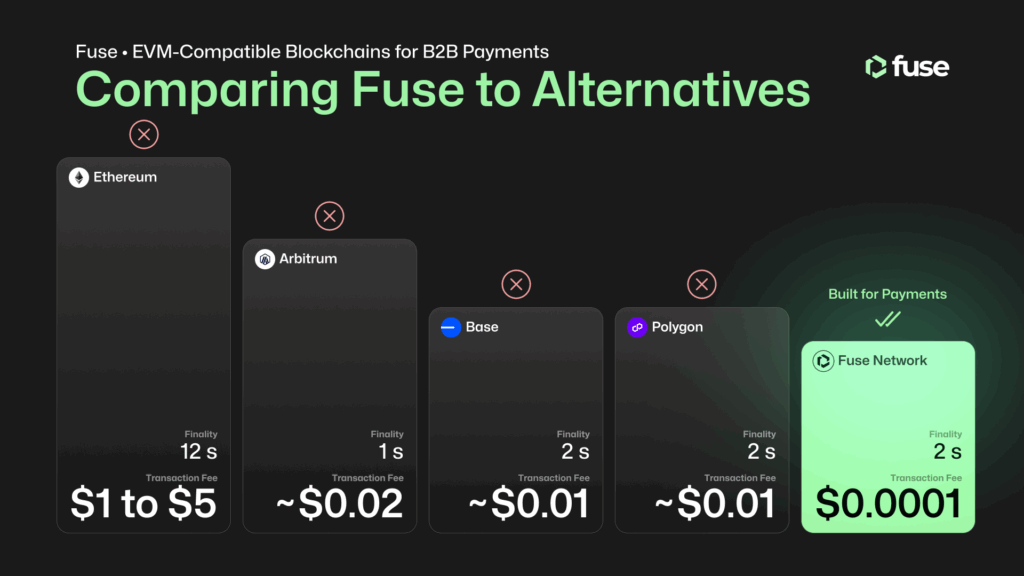
Ethereum, the most widely used EVM chain, charges between $1 and $5 per transaction depending on network conditions. For a business processing thousands of supplier payments or contractor payouts, that fee structure makes onchain payments unworkable.
Other options like Base, Arbitrum, and Polygon bring fees down to $0.01 to $0.05 per transaction, which is better but still adds up at scale. More importantly, they were built as general-purpose computation networks, not payment networks.
Fuse Network charges $0.0001 per transaction, one hundredth of a cent. A business sending 100,000 payments in a month spends $10 in total network fees. That is the cost structure that makes onchain B2B payments genuinely practical.
Fuse’s Performance Specifications
Beyond cost, two other properties define whether a chain is usable for business payment flows:
Finality time: Fuse transactions finalize in approximately 2 seconds. This is fast enough for real-time checkout, instant payroll disbursements, and the kind of synchronous payment confirmation that business workflows require.
Reliability: Fuse Network has operated with zero downtime since its launch in 2019 and has processed over 135 million transactions. For businesses building payment infrastructure, uptime is not optional.
Loyalty Tokens and Branded Stablecoins
Beyond payments, Fuse gives businesses a native way to issue their own onchain assets. Brands can deploy loyalty tokens (custom ERC-20 tokens tied to rewards programs, event access, or customer incentives) at the same $0.0001 per transaction cost. Freedom Wallet’s EPIC Entertainment integration is an example of this in production: event-specific tokens replace cash at the door and across all vendor points.
Businesses with higher-volume payment needs can also issue branded stablecoins pegged to fiat currency, enabling closed-loop payment systems that stay within a brand’s ecosystem. Combined with Fuse’s low fees and 2-second finality, this makes Fuse the practical choice for any company that wants to move beyond generic payment rails and build a proprietary financial layer.
Comparing Fuse to Alternatives
Fuse is the only chain in this comparison that combines sub-cent fees with a purpose-built payment stack, native support for loyalty tokens and branded stablecoins, and a live consumer application layer.
B2B2C in Practice: Solid and Freedom Wallet
The most direct evidence of Fuse’s suitability for B2B payments is the products already running on it.
Solid is a non-custodial neobank built entirely on Fuse Network. Users earn yield on stablecoin savings, spend via a Visa card accepted across 49 countries, and receive SWIFT and ACH bank transfers into a virtual bank account built into the app. Solid demonstrates that Fuse can support the full range of financial product features a business needs to serve end users, not just the settlement layer.
Freedom Wallet, built by Bitazza on Fuse, is a B2B loyalty and payments platform operating across Southeast Asia. Raja Ferry, one of Thailand’s major ferry operators, uses it to process passenger ticket payments. EPIC Entertainment, Thailand’s largest electronic music promoter, has run over 500 onchain transactions across its events using a custom token on Fuse. At Mystic Valley Music Festival, Freedom Wallet replaced all cash transactions with a blockchain-powered payment system.
Both products run on Fuse’s $0.0001 per transaction infrastructure. Neither would be economically viable on a chain with higher fees.
The Full Stack Advantage
Most blockchain projects provide a settlement layer and stop. Fuse owns the entire stack: Fuse Network as the L1 settlement layer, Voltage Finance as the DeFi and liquidity layer, and Solid as the consumer-facing application. For B2B2C payment products, this vertical integration means no gaps between layers and no dependency on third parties for the parts of the stack that matter most to end users.
For businesses that want to build their own payment products on Fuse, the Fusebox SDK and API stack provides smart wallet infrastructure, trade APIs, gasless transactions, and the Fuse MCP Server for AI-native and agentic payment integrations.yers and no dependency on third parties for the parts of the stack that matter most to end users.
Get Started
- Build on Fuse: console.fuse.io/build
- Developer documentation: docs.fuse.io
- Explore Solid: solid.xyz
- Freedom Wallet case study: fuse.io/casestudies/freedom