.svg)

.svg)


.svg)

.svg)


.svg)


%201.svg)
.svg)


%201.svg)
%20(1)%201.svg)
.svg)


.svg)
%201.svg)

Minting a digital representation of a real-world asset (RWA) is only the first step. The real challenge—and the most significant opportunity—lies in making that asset liquid, transferable, and useful for commerce. By 2026, the market will have moved beyond treating tokenized assets as static digital collectibles. The focus is shifting to the payment processing layer that transforms them into programmable, high-velocity capital.
This guide provides a technical and strategic framework for fintech developers, asset managers, and business leaders. You will learn the architecture required to move beyond simple tokenization and build a robust payment system that unlocks the true utility of RWAs. We will cover the core components, implementation steps, and the infrastructure needed to process asset-backed transactions at scale.
What is Tokenized Asset Payment Processing?
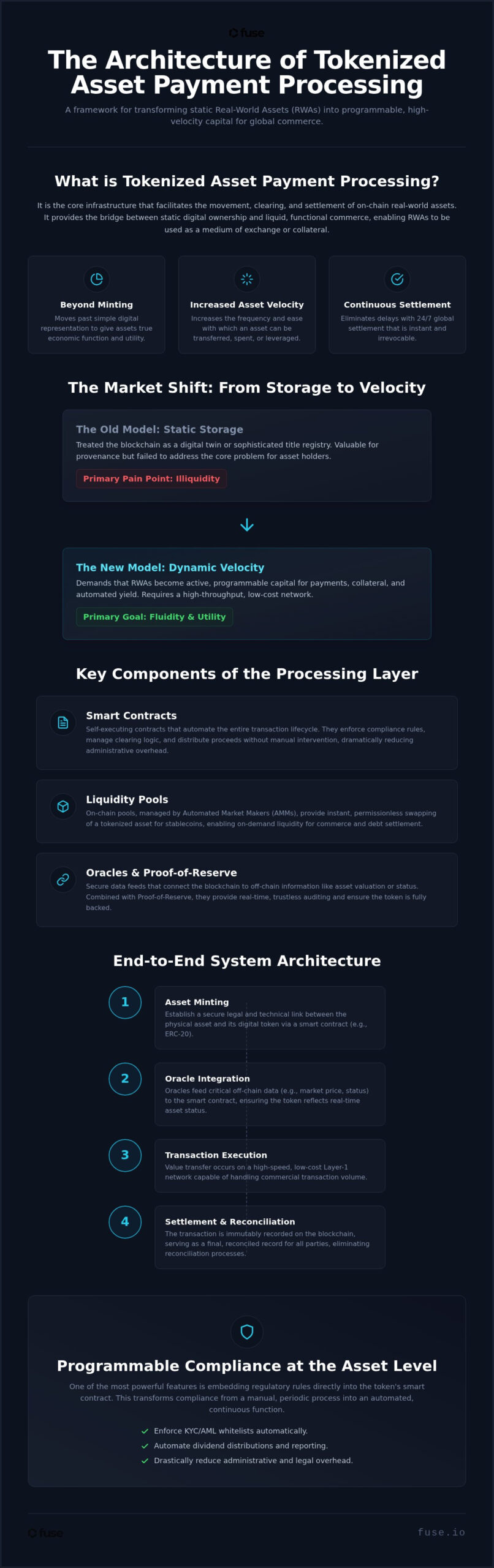
Tokenized asset payment processing is the infrastructure that facilitates the movement, clearing, and settlement of on-chain real-world assets. It is the bridge between static digital ownership and liquid commerce. This system moves beyond the initial act of minting a token to focus on the asset’s velocity and utility, enabling it to be used as a medium of exchange, collateral, or a unit of account in daily transactions.
Unlike traditional finance, which operates within banking hours and relies on intermediaries, a blockchain-based processing layer enables 24/7 global settlement with finality in seconds. It replaces manual, high-friction processes with automated, programmable rules embedded directly into the asset itself.
- Beyond Minting: While tokenization creates a digital representation, payment processing gives it economic function.
- Asset Velocity: The goal is to increase the frequency and ease with which an asset can be transferred, spent, or leveraged.
- Continuous Settlement: On-chain rails eliminate settlement delays, clearing transactions instantly and irrevocably around the clock.
The Shift from Storage to Velocity
For years, the conversation around tokenization centered on creating a “digital twin”—a secure, on-chain record of an off-chain asset. This model treats the blockchain as a sophisticated storage locker or title registry. While valuable for provenance and transparency, it fails to address the primary pain point for asset holders: illiquidity.
By 2026, static tokenization is no longer sufficient. The market demands that RWAs become active, programmable capital. This means transforming a tokenized share of real estate, a private credit instrument, or a government bond into a liquid asset that can be used for instant payments, collateralized borrowing, or automated yield distribution. This requires a high-throughput network capable of handling a high volume of transactions at a negligible cost, making the asset as fluid as a stablecoin.
Key Components of the Processing Layer
A robust tokenized asset payment system is built on three technical pillars that work in concert to ensure trust, efficiency, and compliance.
- Smart Contracts: These self-executing contracts automate the entire transaction lifecycle. They enforce compliance rules (e.g., KYC/AML whitelists), manage clearing logic, and distribute proceeds without manual intervention, dramatically reducing administrative overhead.
- Liquidity Pools: On-chain liquidity pools, managed by Automated Market Makers (AMMs), are essential for utility. They allow for the instant, permissionless swapping of a tokenized asset for a stablecoin or other digital currency, providing the on-demand liquidity needed for point-of-sale transactions or debt settlement.
- Oracles and Proof-of-Reserve: Oracles are data feeds that securely connect the blockchain to off-chain information, such as asset valuation, status, or interest rates. Combined with cryptographic Proof-of-Reserve, these systems provide real-time, trustless auditing, assuring all parties that the on-chain token is fully backed by the underlying real-world asset.
The Architecture of a Tokenized Payment System
Building an end-to-end system for processing RWA payments involves a logical workflow that connects the physical asset to its on-chain digital counterpart and enables its seamless transfer. This architecture is designed for security, compliance, and interoperability.
- Asset Minting: The process begins by establishing a secure legal and technical link between the physical or financial asset and its digital token. This involves legal structuring, due diligence, and the deployment of a smart contract (typically an ERC-20 or ERC-721 standard) that represents ownership.
- Oracle Integration: Once minted, the token must reflect the real-time status of the underlying asset. Oracles are integrated to feed critical data on-chain, such as market price from an appraiser, rental income status, or interest rate adjustments from a central bank.
- Transaction Execution: When a payment is initiated, the value transfer occurs on a Layer-1 network. The network must be capable of executing transactions with high speed and low cost to be viable for commercial use.
- Settlement and Reconciliation: The transaction is finalized when it is immutably recorded on the blockchain ledger. This single entry serves as the final, reconciled record for all parties, eliminating the need for separate ledgers and post-trade reconciliation processes.
Programmable Compliance at the Asset Level
One of the most powerful features of a tokenized asset system is the ability to embed regulatory rules directly into the token’s smart contract. This transforms compliance from a manual, periodic process into an automated, continuous function.
For example, a token representing a security can be programmed to only be transferable between whitelisted, KYC-verified wallets. This ensures that every transaction automatically adheres to jurisdictional regulations without the need for a transfer agent. Legal structures like Special Purpose Vehicles (SPVs) can also be managed through smart contracts, automating shareholder voting, dividend distribution, and reporting. This trustless, self-executing code drastically reduces administrative and legal overhead.
The Role of EVM Compatibility
The Ethereum Virtual Machine (EVM) has become the de facto standard for smart contract development. For businesses building tokenized asset solutions, choosing an EVM-compatible blockchain is a critical strategic decision. It provides access to the largest ecosystem of developer tools, established code libraries, and security auditing services in the world.
Developers can leverage existing Ethereum tools like Hardhat, Truffle, and OpenZeppelin’s contract standards to accelerate deployment on an EVM-compatible Layer-1 like the Fuse Network. This reduces the learning curve and time-to-market. Furthermore, EVM compatibility ensures interoperability, allowing tokenized assets to move seamlessly across the broader Web3 ecosystem via bridges, connecting them to deeper liquidity and a wider range of DeFi applications.
RWAs as Collateral: The New Frontier of Liquidity
The ultimate goal of tokenized asset payment processing is to unlock the trillions of dollars locked in illiquid real-world assets. By making these assets divisible, transferable, and programmable, they can be used as high-quality collateral within both traditional and decentralized financial systems, creating new avenues for capital efficiency.
- Fractionalization: High-value assets like commercial real estate or fine art can be broken into millions of micro-units. This allows for broader ownership and enables small fractions to be used as spendable capital.
- Asset-Backed Lending: An owner of a tokenized property can instantly borrow stablecoins against their holdings from a decentralized lending protocol, providing immediate cash flow without selling the underlying asset.
- Streaming Payments: The yield generated by an asset—such as rental income or bond coupons—can be streamed directly to token holders in real-time, automating distributions to global stakeholders with minimal cost.
- The ‘Spendable RWA’: This is the final frontier, where a user can pay for everyday goods and services at a point of sale using a fraction of their tokenized gold, T-bills, or real estate portfolio.
DeFi Integration for Real-World Value
For too long, Decentralized Finance (DeFi) has been a self-referential system, with yield primarily driven by speculation on crypto-native assets. RWAs change this dynamic by introducing collateral backed by real economic activity. Using tokenized U.S. T-bills as the “risk-free” collateral for decentralized protocols introduces a new level of stability and trust. Fintechs and DAOs can diversify their treasuries with on-chain, asset-backed reserves, reducing their exposure to the volatility of purely digital assets and generating sustainable yield from predictable, off-chain cash flows.
Solving the Last-Mile Payment Problem
Bridging the gap between a powerful on-chain ledger and a user’s mobile device is the most critical challenge for adoption. A tokenized asset is only useful if it can be easily managed and spent by non-technical users. This is the “last-mile” payment problem.
The solution lies in mobile-first SDKs and account abstraction. Technologies like ERC-4337 allow for the creation of smart contract wallets that vastly improve user experience. They enable features like gasless transactions (where the application sponsors the network fee), social recovery, and simple login credentials instead of complex seed phrases. By using a dedicated SDK like FuseBox, developers can build non-custodial wallets and payment applications that offer the simplicity of a Web2 app with the security and self-sovereignty of Web3.
How to Implement Tokenized Asset Payments in 5 Steps
Deploying a functional tokenized asset payment system requires a methodical approach that covers legal, technical, and user-facing components. This five-step process provides a high-level roadmap for businesses entering this space.
- Select and Structure the Asset: Identify a physical or financial asset with strong value and liquidity potential. Work with legal counsel to structure the asset in a bankruptcy-remote entity (like an SPV) that can legally be represented by a digital token.
- Deploy the Smart Contract: Choose an EVM-compatible blockchain and develop the smart contract that will govern the token. Use established standards like ERC-20 for fungible assets or ERC-721 for non-fungible assets to ensure maximum compatibility. Embed compliance logic, such as transfer restrictions, directly into the contract.
- Integrate Oracles for Data Feeds: Connect the smart contract to a reliable oracle network to ensure the digital token accurately reflects the real-world status of the asset. This is crucial for valuation, performance data, and triggering automated events.
- Set Up the Payment Rail: Choose a Layer-1 network optimized for payments. The network must provide high throughput, predictable low costs, and fast finality. A network with transaction costs of ~$0.0001 and sub-2 second finality is essential for processing high-frequency, low-value movements of fractionalized assets.
- Launch the Mobile Interface: Use an SDK to build the user-facing application or wallet. Focus on abstracting away blockchain complexity. The interface should allow users to view their asset holdings, send and receive payments, and interact with liquidity pools seamlessly.
Optimizing for Low Transaction Costs
High and volatile gas fees are the single greatest barrier to the utility of fractionalized assets. If a single transaction costs several dollars, it becomes economically unviable to move a $5 fraction of a tokenized asset. This destroys liquidity and limits use cases to large, infrequent transfers.
Therefore, selecting a network purpose-built for low-cost payments is non-negotiable. A blockchain that supports sub-cent transactions is required to enable micro-movements, streaming payments, and other high-frequency use cases. Network speed is equally important; slow confirmation times erode user trust and are unacceptable for real-time payment applications.
Regulatory and Compliance Checkpoints
Navigating the regulatory landscape is paramount. Implementing whitelisting capabilities within the smart contract allows for the creation of permissioned asset pools, restricting transfers to only authorized participants. Identity verification (KYC/AML) processes must be managed carefully to balance compliance with a smooth user experience, often by integrating with established digital identity providers.
As global standards for digital securities evolve towards 2026, it is crucial to build systems with flexible, programmable compliance that can be updated to meet new requirements without re-architecting the entire solution.
Scaling RWA Liquidity with Fuse: The Fast-Track to On-Chain Assets
To move from theory to implementation, developers and businesses need production-ready infrastructure. Fuse provides a complete, B2B-focused technology stack designed specifically for deploying high-performance, low-cost payment systems for tokenized assets. Operating since 2019, the Fuse ecosystem is built on a veteran foundation of stability and real-world utility.
The core of the offering is the Fuse Network, a dedicated, EVM-compatible Layer-1 blockchain optimized for last-mile payments. It is complemented by a suite of developer tools that solve key challenges in user onboarding, wallet creation, and dApp management.
- Fuse Network: The Layer-1 payment rail, offering sub-2 second finality and transaction fees of approximately $0.0001.
- FuseBox: An SDK built on ERC-4337 account abstraction, enabling developers to build consumer-ready mobile wallets with gasless transactions and simple user onboarding.
- Fuse Console: A developer dashboard for deploying and managing smart contracts, monitoring dApp activity, and accessing network services.
- Fuse Bridge: An interoperability solution for moving assets securely between Fuse and other major EVM chains like Ethereum, BNB Chain, and Polygon.
Why Builders Choose Fuse for RWAs
Fuse is not a general-purpose blockchain; it is purpose-built for payments. This focus provides tangible advantages for businesses building RWA solutions. The network’s ultra-low fees are designed to support the high-velocity movements required for fractional asset utility. The modular developer stack, including FuseBox and the Fuse Console, is engineered to accelerate time-to-market for asset-backed applications.
The credibility of the network is backed by proven performance metrics:
- 7+ Years of Operation: Live and stable since 2019.
- Proven Scale: Over 200 million total transactions processed.
- High Reliability: 99.9% network uptime.
- Large Ecosystem: Home to over 150 integrated Web3 projects and businesses.
Deploying Your First RWA Solution on Fuse
The Fuse stack provides a clear, efficient path for launching a tokenized asset payment service. Developers can leverage their existing EVM knowledge to build quickly and confidently.
- Build: Use the Fuse Console to deploy and manage your RWA smart contracts on the Fuse Network.
- Integrate: Implement the FuseBox SDK into your application to create non-custodial, smart contract wallets that offer a seamless user experience with account abstraction.
- Scale: Leverage the high throughput and near-zero cost of the Fuse Network to enable global, real-time settlement for your tokenized assets.
Start Building your tokenized asset solution on Fuse.
Frequently Asked Questions (FAQs)
What is tokenized asset payment processing?
It is the end-to-end system that allows digital tokens representing real-world assets (RWAs) to be transferred, cleared, and settled on a blockchain. It focuses on making these assets liquid and usable for commerce, moving beyond simple digital ownership.
Is it legal to use tokenized real estate for payments?
The legality depends on the jurisdiction and how the asset is structured. Most tokenized real estate is considered a security, and its transfer must comply with local securities laws. Using programmable smart contracts to enforce these rules is a key part of a compliant system.
How do oracles ensure the security of tokenized assets?
Oracles do not secure the asset itself but ensure data integrity. They act as secure data bridges, fetching external information (like asset price or status) and delivering it to the blockchain. Using decentralized oracle networks prevents a single point of failure and manipulation of the data that smart contracts rely on.
What are the benefits of fractionalized real-world assets?
Fractionalization democratizes access to high-value assets by breaking them into smaller, affordable units. This increases liquidity by creating a larger pool of potential buyers and sellers and allows fractions to be used for payments or as collateral.
How does Fuse Network reduce the cost of RWA transactions?
Fuse Network is a Layer-1 blockchain designed for efficiency. It uses a Delegated Proof of Stake (DPoS) consensus mechanism that allows for high throughput and keeps transaction fees consistently low, at approximately $0.0001. This makes it economically feasible to process a high volume of small transactions.
Can I spend tokenized assets at a regular point-of-sale?
Directly, this is still emerging. The more common model involves a mobile wallet that facilitates an instant, behind-the-scenes swap. The user spends the RWA, but the wallet swaps it for a stablecoin or fiat currency via a liquidity pool, and the merchant receives traditional currency.
What is the difference between RWA tokenization and standard crypto?
Standard cryptocurrencies like Bitcoin or Ether are native to the blockchain. Their value is determined by market dynamics. RWA tokens are digital representations of assets that exist off-chain, such as real estate, bonds, or private credit. Their value is directly linked to and backed by the underlying real-world asset.
How do I ensure my tokenized asset project is compliant?
Compliance is critical and complex. It requires engaging with legal experts specializing in digital securities and financial regulations in your target jurisdictions. Technical solutions like programmable smart contracts with whitelisting and transfer restrictions are tools to enforce compliance, not a substitute for a robust legal framework.