.svg)

.svg)


.svg)

.svg)


.svg)


%201.svg)
.svg)


%201.svg)
%20(1)%201.svg)
.svg)


.svg)
%201.svg)

More than 40% of the total Ethereum supply is currently staked. For fintech leaders and neobank architects, this data point signals a massive shift. Staking has evolved from a passive yield experiment into a core treasury requirement. You recognize the inefficiency of letting capital sit idle in wallets while your business pays for legacy infrastructure. Crypto staking for businesses offers a way to flip that script. It turns your digital assets into the very engine that secures your payment rails.
It’s time to move beyond the uncertainty of slashing risks and the technical friction of validator management. You need a strategy that prioritizes security and compliance. This guide provides a clear path to deploying a low-risk staking model that supports your own consumer applications. We’ll explore how to optimize capital on an EVM-compatible Layer-1 that has processed over 200 million transactions since 2019. You’ll learn to distinguish between speculative yield farming and the sustainable infrastructure rewards found within the Fuse ecosystem, where transaction costs are approximately $0.0001 and sub-2 second finality is the standard.
Key Takeaways
- Transform idle digital assets into a strategic treasury tool that secures your payment infrastructure.
- Understand the protocol-level mechanics of Proof-of-Stake (PoS) to participate in network consensus without managing complex validator hardware.
- Deploy a risk-adjusted strategy for crypto staking for businesses by distinguishing between high-complexity DeFi yield farming and stable protocol-level rewards.
- Follow a structured implementation framework to audit surplus assets and integrate with a production-ready Layer-1 network backed by a seven-year track record.
- Scale consumer payment applications on EVM-compatible infrastructure featuring sub-2 second finality and transaction costs of approximately $0.0001.
The Strategic Value of Crypto Staking for Modern Business Treasuries
Digital assets sitting in cold storage represent a missed opportunity. In the 2026 financial environment, neobanks and fintechs treat their balance sheets as active participants in network security. Crypto staking for businesses transforms static capital into a functional component of the payment stack. It moves businesses from being mere observers to becoming stakeholders in the very infrastructure they rely on. By staking FUSE, companies ensure the payment rails they use remain fast, secure, and accessible.
Beyond Idle Assets: Capital Efficiency in Web3
Traditional treasuries often rely on low-yield bonds or money market accounts. While these provide safety, they lack the direct utility found in decentralized ecosystems. Crypto staking for businesses introduces a non-dilutive revenue stream that directly offsets operational overhead. For a fintech startup, these rewards can cover the costs of maintaining gasless transactions for their users. It’s about maximizing every dollar. You balance immediate liquidity needs with long-term network health. This isn’t just about holding; it’s about building. Staking provides a way to grow a treasury without selling assets or diluting equity.
Staking as a Security Layer for Payment Infrastructure
Security is the primary concern for any payment provider. The strength of a network depends on its consensus mechanism. By participating in Proof-of-Stake (PoS), businesses contribute to the overall resistance against attacks. A higher total value staked means a more resilient network. Since its launch in 2019, Fuse has maintained 99.9% uptime across over 200 million total transactions. This stability isn’t accidental. It’s a direct result of a decentralized validator set. Businesses building on Fuse benefit from this robust foundation.
Practical application matters more than theory. Take Solid, for example. This neobank utilizes on-chain mechanisms to provide stablecoin yield to its users, demonstrating how staking infrastructure supports high-performance consumer apps. When you stake, you aren’t just earning; you’re reinforcing the rails of your own business. It’s a symmetrical relationship. The business provides capital to secure the network, and the network provides the sub-2 second finality and low costs required to scale.
Understanding Proof-of-Stake (PoS) Economics for Enterprise
Proof-of-Stake (PoS) is the technical foundation of modern decentralized finance. Unlike energy-intensive mining, PoS relies on validators who commit digital assets as collateral to secure the network. These participants are selected to verify transactions based on the size of their stake. For the Fuse Network, this mechanism has been operational since 2019, providing a stable environment for over 200 million transactions. When evaluating crypto staking platforms, businesses must look beyond simple yield and focus on the underlying economic security of the Layer-1 rails.
Economic incentives drive the entire system. ROI for crypto staking for businesses is generated through block rewards and a share of network transaction fees. As the network scales, the rewards reflect the increasing utility of the infrastructure. Maintaining a 99.9% uptime record is the standard for any enterprise-grade validator. This level of availability ensures that sub-2 second finality remains consistent for all ecosystem participants. You aren’t just earning a return; you’re maintaining the throughput of a global payment system.
Validator Nodes vs. Delegation: Choosing Your Participation Level
Businesses face a choice between direct infrastructure management and delegation. Running a validator node offers the highest level of technical control and allows the organization to retain 100% of the generated rewards. However, it requires robust server maintenance to meet the strict sub-2 second finality requirements. Delegation is the alternative for those seeking lower technical friction. By delegating FUSE to an existing, trusted validator, you participate in network security and earn rewards without the overhead of node management. Both paths contribute to the decentralization and resilience of the ecosystem.
Slashing Risks and Mitigation Strategies for Corporate Stakers
Slashing is the protocol’s primary mechanism for enforcing network integrity. If a validator experiences significant downtime or acts maliciously, a portion of their staked capital is permanently seized. For corporate treasuries, this is a manageable risk. Mitigation starts with selecting non-custodial solutions and professional-grade infrastructure. Using the Fuse Console simplifies this process by providing a streamlined interface for managing your staking positions and monitoring performance metrics. This ensures your capital remains productive while minimizing exposure to technical failure. To begin optimizing your treasury, explore the production-ready tools available at fuse.io.
Yield Farming vs. Staking: A Risk-Adjusted Comparison for Businesses
Choosing the right treasury strategy requires a clear understanding of risk profiles. Yield farming and staking are often grouped together, but they serve different purposes for a corporate balance sheet. Yield farming involves providing liquidity to decentralized finance (DeFi) pools. It’s a high-reward, high-complexity activity that requires active management. In contrast, crypto staking for businesses is a protocol-level commitment. It focuses on securing the underlying Layer-1 rails. While yield farming relies on market-making dynamics, staking rewards are a direct result of network participation and transaction validation.
Risk assessment is the deciding factor for most fintech decision-makers. Yield farming exposes a treasury to impermanent loss, where the value of your deposited assets fluctuates against the pool ratio. Staking risks are primarily technical. Slashing remains the main concern, though it’s manageable through professional infrastructure and high-uptime validators. The institutional credibility of crypto staking has strengthened as businesses look for predictable, protocol-backed returns rather than speculative DeFi incentives. For most B2B frameworks, the stability of a 99.9% uptime network is more valuable than the volatile peaks of liquidity mining.
Liquidity Considerations: Liquid Staking vs. Traditional Locking
Capital mobility is vital for operational efficiency. Traditional staking often involves lock-up periods that can restrict cash flow during market shifts. Liquid staking has emerged as a pragmatic middle ground. It allows businesses to stake their assets and receive a liquid derivative token in return. You earn rewards while maintaining the ability to bridge assets or use them as collateral. Within the EVM-compatible ecosystem, evaluating these providers is a key step in a crypto staking for businesses strategy. It ensures that your treasury remains agile without sacrificing the security benefits of network participation.
Assessing Yield Sustainability in Volatile Markets
Sustainable yield is the only metric that matters for long-term enterprise integration. Rewards generally come from two sources: token inflation and transaction fees. A healthy network shifts toward fee-based rewards as adoption grows. The Fuse Network’s history of over 200 million total transactions since 2019 demonstrates a consistent demand for its payment infrastructure. When transactions cost ~$0.0001 and settle with sub-2 second finality, the network attracts real-world usage. This usage drives the fees that support validator rewards. It’s a transparent, builder-focused model that avoids the “black box” risks associated with high-complexity yield aggregators. Explore how to integrate these stable rails at fuse.io.
Implementation Framework: Deploying a Corporate Staking Strategy
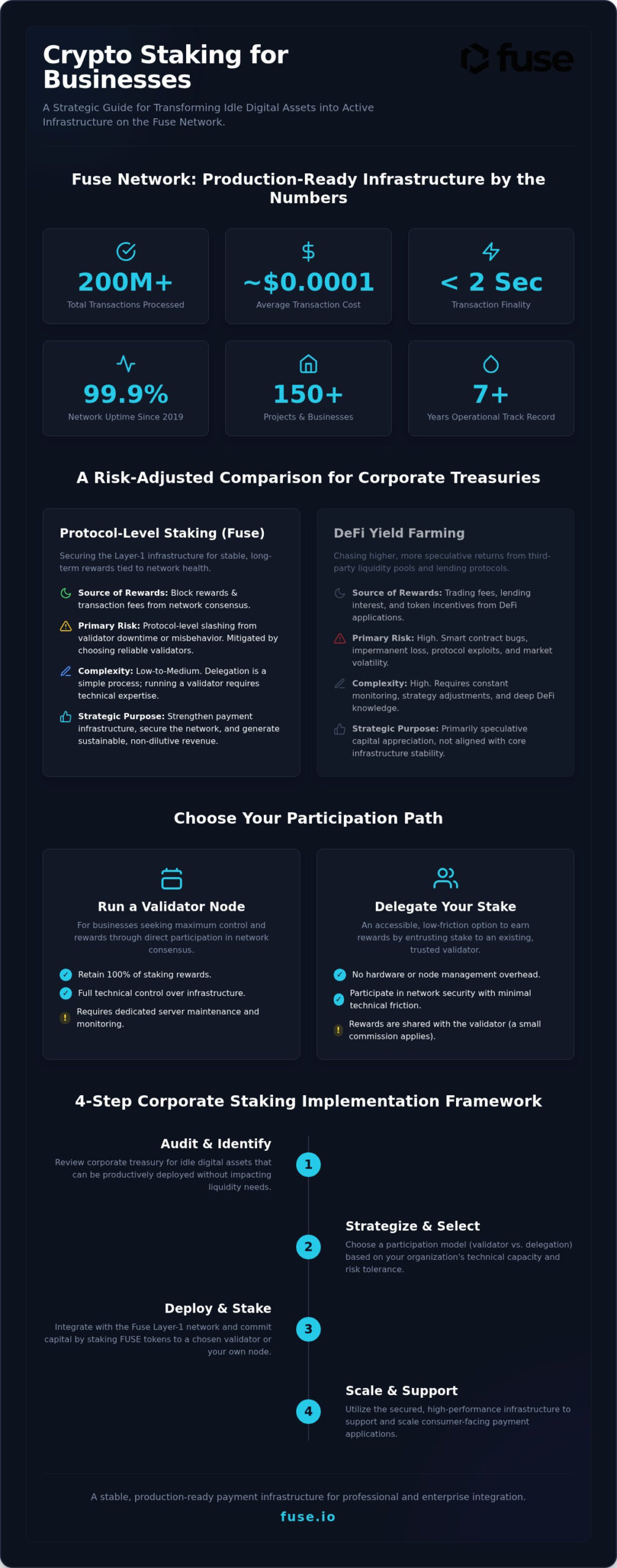
Successful deployment of crypto staking for businesses requires a transition from theoretical interest to technical execution. You need a structured framework to manage risk and maximize efficiency. Start with a comprehensive audit of your digital asset holdings. Identify the stakable surplus capital that isn’t required for immediate operational liquidity. This identifies your capacity for network participation. Once your capital is mapped, select a network built for professional use. The Fuse Network has provided stable payment rails since 2019. Seven years of mainnet history and 200 million transactions provide the necessary track record for enterprise integration.
Choose your participation model based on internal resources. If your team has the capacity for server management, running a validator node offers maximum control. If you prioritize speed to market, delegation allows you to earn rewards by supporting existing, trusted validators. Integrate these workflows into your corporate accounting and reporting tools immediately. Staking is a treasury function. It requires visibility. Use management portals to monitor performance and uptime. Your primary goal is to maintain the 99.9% availability required for sub-2 second finality on the network.
Compliance and Reporting: Navigating On-Chain Rewards
Regulatory and audit requirements demand precision. You must track every reward payout for tax purposes. Non-custodial staking is the preferred model for enterprise security. It ensures your business retains ownership of the principal assets at all times. Use FuseBox to automate reward tracking for your payment applications. It removes the need for manual data entry and provides a clear audit trail for on-chain activities. This is critical for neobanks and fintechs operating in highly regulated environments. Automated tracking ensures that your treasury data remains accurate and ready for reporting.
Technical Setup: Integrating Staking via APIs and SDKs
Builders prioritize speed and scalability. Use the FuseBox SDK to integrate staking features directly into your consumer apps. This allows your users to interact with the underlying protocol through your own interface. Leverage account abstraction (ERC-4337) to remove technical friction. This technology enables gasless transactions and automated staking logic, creating a seamless user experience. Manage your infrastructure through the Fuse Console. For a flat rate of $50 per month, the console provides a unified dashboard for managing API keys, monitoring validator status, and tracking network performance. You focus on the business logic. We provide the payment rails. Build your production-ready infrastructure at fuse.io.
Scaling with Fuse: Payment-First Staking Infrastructure
Fuse is the destination for consumer-scale payments. It is an EVM-compatible Layer-1 optimized for high-volume throughput and immediate utility. Since 2019, the network has matured into a stable, production-ready environment. It currently supports 8 million addresses and processes 25,000 daily transactions with ease. For those implementing crypto staking for businesses, this scale provides the necessary confidence. You aren’t testing a prototype. You are integrating with an ecosystem that has successfully handled over 200 million total transactions over a seven-year track record.
Economics dictate the success of any payment application. High fees on legacy chains destroy margins and prevent mass adoption. Fuse solves this problem. Transaction costs of approximately $0.0001 allow for gasless transactions that feel like traditional web apps to the end user. The stack is vertically integrated for maximum efficiency. You get the Layer-1 chain, the FuseBox SDK for account abstraction (ERC-4337), and the Console for management. It’s a complete toolkit for the modern fintech architect who values speed and cost-effectiveness.
Securing the Fuse Network: Benefits for Payment Providers
Staking FUSE does more than generate treasury rewards. It directly supports the “last-mile” mission of global payments. Every staked token increases the resilience of the rails your business depends on. The Fuse Foundation has supported this ecosystem since 2019, ensuring long-term alignment with the needs of over 150 projects. Reliability is further reinforced through deep integrations with partners like Circle and The Graph. These collaborations ensure that stablecoin payments and on-chain data indexing meet the rigorous standards of enterprise reliability. By staking, you reinforce the 99.9% uptime that keeps the network running.
Leveraging the Fuse Console for Enterprise Management
Operational efficiency requires reducing technical friction. The Fuse Console offers a streamlined management experience for a flat rate of $50 per month. You don’t need a massive DevOps team to manage your infrastructure. Use the portal to deploy payment features, monitor validator performance, and manage your non-custodial staking positions. It provides the high-level visibility required for professional digital asset management and sub-2 second finality monitoring. Secure your payment future and start your deployment today. Build on Fuse to access the full developer documentation and start your integration.
Secure Your Payment Rails with Strategic Staking
Modern treasuries require more than passive holding. You’ve seen how staking transforms idle surplus into active security for your payment infrastructure. By choosing protocol-level participation over speculative DeFi models, you ensure long-term sustainability. You gain predictable rewards while maintaining the rails your consumer apps rely on. It’s a pragmatic shift from holding to building.
The road to enterprise-grade Web3 payments is paved with proven data. Fuse has supported the ecosystem since 2019. It has processed over 200 million transactions for more than 150 projects globally. As you integrate crypto staking for businesses into your operational model, you join a network built for professional scale. Use the vertical stack of the Layer-1, FuseBox SDK, and Console to remove technical friction. It’s time to optimize your capital and lead the next wave of fintech innovation.
Build your payment infrastructure on Fuse
Frequently Asked Questions
Is crypto staking safe for corporate treasuries?
Crypto staking is safe when managed through non-custodial frameworks and production-ready networks. The main risk is slashing due to validator downtime or malicious activity. Choosing a Layer-1 with 99.9% uptime since 2019 significantly mitigates these technical concerns. Unlike speculative trading, staking focuses on network security. It provides a grounded approach for corporate treasuries to maximize capital efficiency while maintaining ownership of their principal assets.
What is the difference between staking and yield farming for businesses?
Staking involves securing the underlying network rails, while yield farming focuses on providing liquidity to DeFi protocols. Crypto staking for businesses offers a more predictable reward structure based on protocol inflation and transaction fees. Yield farming introduces higher complexity and the risk of impermanent loss. For most corporate treasuries, protocol-level staking is the preferred method for generating sustainable, low-risk returns on digital asset holdings.
How much can a business earn through FUSE staking in 2026?
Rewards are determined by network participation and transaction volume. By the end of 2025, FUSE staking APR reached approximately 6.8%. These figures reflect the protocol’s move toward sustainable, usage-driven economics. As transaction volume grows across the 8 million network addresses, fee-based rewards become a more significant component of the total ROI. This provides a consistent revenue stream to help businesses offset their operational costs.
Do we need to run our own validator node to participate?
Participation does not require running dedicated hardware. While running a validator node offers full control and requires a minimum of 100,000 FUSE, delegation is a faster alternative. By delegating tokens to existing validators, your business earns rewards without managing server uptime or meeting the sub-2 second finality requirements. This lowers the barrier to entry for fintechs and neobanks that want to participate in network security without intensive technical overhead.
What are the liquidity risks associated with staking lock-up periods?
Lock-up periods can restrict immediate access to capital, creating potential cash flow challenges. Liquid staking mitigates this risk by issuing derivative tokens that represent your staked position. These tokens remain mobile and can be used within the EVM-compatible ecosystem for payments or collateral. This ensures that your treasury stays agile. You can respond to market shifts or operational needs without waiting for traditional unbonding periods to expire.
How does account abstraction (ERC-4337) simplify staking for business users?
Account abstraction removes the traditional barriers to entry for non-technical users. It allows for gasless transactions and programmable wallet logic. By using FuseBox, developers can automate the staking process within their own consumer applications. This means your users don’t have to manage gas fees or interact directly with complex smart contracts. It simplifies the user experience while maintaining the security of the underlying Layer-1 infrastructure.
Can we stake stablecoins like USDC or USDT on the Fuse Network?
Protocol-level staking is exclusive to the FUSE token because it is the native asset used to secure the network. Stablecoins like USDC and USDT are used for payments and liquidity but do not participate in the PoS consensus mechanism. However, businesses can utilize these stablecoins in DeFi pools to earn yield. This complements a crypto staking for businesses strategy by diversifying how the treasury generates returns across different asset classes.
How do we report crypto staking rewards for corporate tax purposes?
Reporting requires precise tracking of reward payouts at the time they are received. You must maintain a clear audit trail for every on-chain transaction to satisfy corporate tax and compliance requirements. Using the Fuse Console or FuseBox SDK simplifies this by providing automated data exports and real-time monitoring. This ensures your financial team has the data needed for accurate reporting. Always consult with a qualified tax advisor for local compliance.