.svg)

.svg)


.svg)

.svg)


.svg)


%201.svg)
.svg)


%201.svg)
%20(1)%201.svg)
.svg)


.svg)
%201.svg)

The era of treating decentralized finance as a playground for speculators has ended. By mid-2026, the focus has shifted entirely to utility. Smart leaders are now deploying decentralized finance infrastructure for business to replace aging, expensive payment systems. It’s about efficiency. It’s about scale. It’s about moving capital without the friction of legacy banking.
You’ve likely felt the sting of high gas fees on legacy chains or lost users to complex onboarding flows. These are the traditional barriers to Web3 adoption. This report shows you how to bypass those hurdles using production-ready payment rails and account abstraction. We’ll explore how sub-2 second finality and gasless transactions are driving a new standard for global payments. You will see how infrastructure with a seven-year track record and over 200 million successful transactions is transforming DeFi from a complex experiment into a reliable, non-custodial foundation for your enterprise. We cover the move toward sub-cent transaction costs and the seamless UX required for non-crypto users to interact with your platform.
Key Takeaways
- Learn how decentralized finance infrastructure for business provides the programmable rails needed for high-volume, utility-driven value movement.
- Understand the role of account abstraction (ERC-4337) in removing technical friction for non-crypto users through gasless transactions.
- Analyze the necessity of sub-2 second finality and ~$0.0001 transaction costs for achieving enterprise-level scalability and merchant trust.
- Identify real-world use cases for stablecoin payments and non-custodial neobanks within emerging markets like SE Asia and LATAM.
- Evaluate the benefits of building on a veteran Layer-1 stack with a seven-year track record and over 200 million total transactions.
Defining Modern DeFi Infrastructure for Business
Traditional finance relies on fragmented intermediaries. Modern business requires programmable rails. This is the core of decentralized finance infrastructure for business. It is not about yield farming or speculative tokens. It is about moving value with the same precision you move data. While Decentralized Finance (DeFi) began as a retail experiment, it has transitioned into an enterprise-grade utility stack. The infrastructure is now the plumbing for a global economy that never sleeps.
Businesses are migrating from legacy systems like SWIFT and ACH. These systems are slow. They are expensive. They operate on banking hours in a digital world. On-chain stablecoin rails offer a superior alternative, providing instant transparency and lower overhead. By utilizing an EVM-compatible Layer-1, developers gain the flexibility of Ethereum with the performance required for global commerce. This interoperability ensures that a business can integrate with existing tools while future-proofing its payment stack against technical silos.
The Evolution from Speculation to Utility
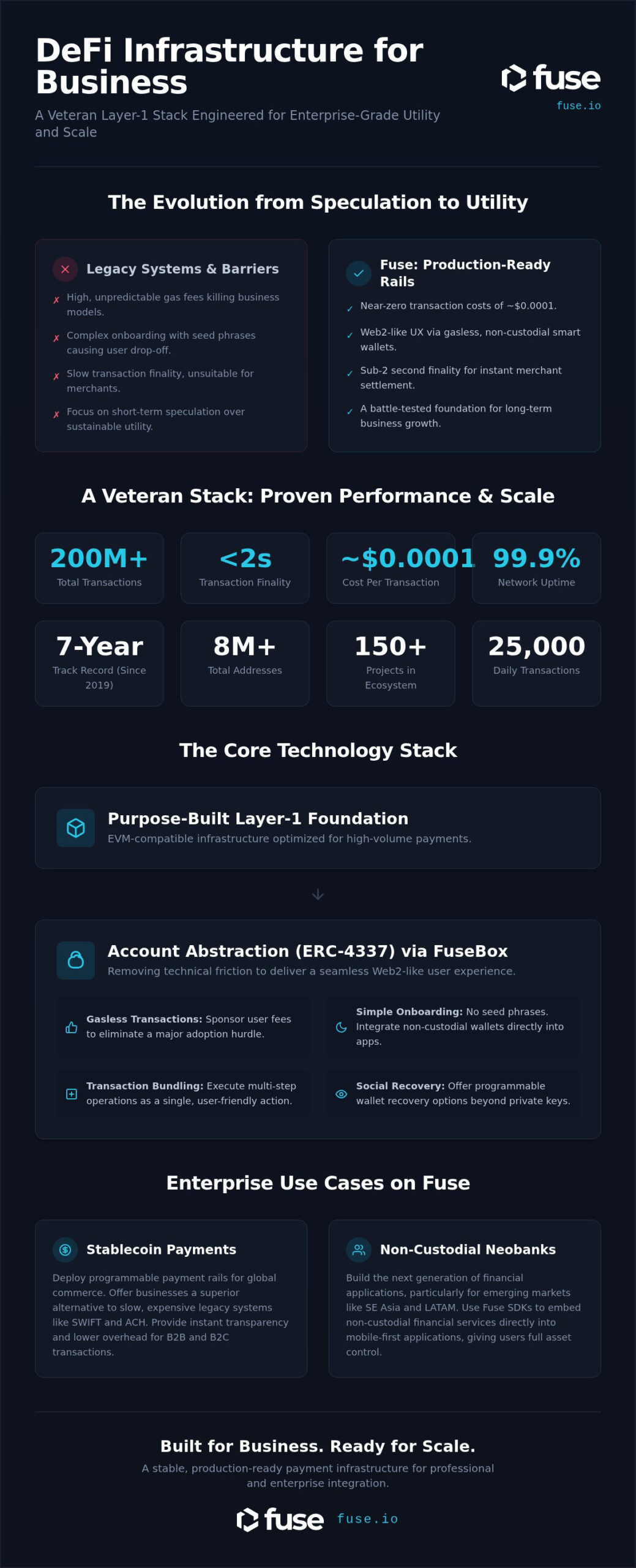
The 2019-2026 cycle filtered out the noise. What remains is a battle-tested foundation. Professional neobanks and fintechs don’t care about hype; they care about a seven-year track record and 99.9% uptime. Business DeFi infrastructure is a vertically integrated stack consisting of a Layer-1 blockchain, SDKs, and APIs. With over 200 million total transactions and 8 million addresses, the technology has moved past the proof-of-concept stage. It is now a production-ready environment supporting over 150 projects. This maturity has built the institutional trust necessary for large-scale deployment.
The Layer-1 Foundation for Payments
General-purpose chains often struggle with congestion. High fees kill business models. For mass adoption, transaction costs must stay near ~$0.0001. Speed is equally critical. Consumers expect instant confirmation, and merchants need liquidity. Sub-2 second finality is the benchmark for merchant settlement and user trust. Maintaining this performance while managing 25,000 daily transactions requires a purpose-built architecture. It balances the security of decentralization with the throughput of a modern payment network. The result is a system where the “blockchain” part becomes invisible to the end user. It just works. It scales. It removes the friction that has held back digital payments for decades.
Account Abstraction: Scaling Enterprise UX in 2026
Web3 adoption once stalled due to technical friction. Seed phrases and manual gas management created barriers for non-technical users. Account abstraction (ERC-4337) has removed these hurdles. It allows businesses to offer a Web2-like experience while maintaining the security of decentralized finance infrastructure for business. Smart wallets now eliminate the need for users to manage private keys manually. Instead, you can integrate non-custodial wallet APIs directly into existing mobile banking apps. This shift is essential for fintechs targeting mass-market users who demand simplicity without compromising security.
The strategic benefits extend into regulatory and policy considerations. A comprehensive overview of DeFi research notes that technical advancements like smart accounts are key to reducing operational risks. For your business, this means the ability to offer gasless transactions. Sponsoring user fees increases retention and lowers the barrier to entry. Users interact with stablecoin payments without ever knowing they are on a blockchain. It’s a pragmatic approach to scaling financial products in a competitive market.
Simplifying On-Chain Transactions
Complexity is the enemy of conversion. ERC-4337 enables transaction bundling. This allows multiple steps to be executed as a single signed action. It feels like a standard digital checkout. Businesses utilize FuseBox to deploy these embedded wallets quickly. The architecture is strictly non-custodial. This is a critical requirement for corporate compliance. You provide the financial utility while the user retains asset control. It’s a stable, professional solution for modern fintech deployment.
Programmable Money for Mobile Apps
The days of external browser extensions are over. Integrated financial features are now the standard for mobile-first neobanks. SDKs allow developers to build custom transaction logic such as recurring payments or social recovery. These tools aren’t theoretical. The Zneakrz case study demonstrates how smart wallets handle high-frequency micro-transactions in a live environment. You can evaluate the stack to see how these features bridge the gap between legacy banking and on-chain efficiency. The result is a high-performance app that delivers sub-2 second finality to every user.
The Economics of Scale: Transaction Costs and Latency
Mass adoption requires micro-transaction viability. If a transaction costs more than a fraction of a cent, the business model fails. Successful decentralized finance infrastructure for business demands that costs remain below $0.001. Legacy rails can’t compete with this efficiency. Ethereum gas costs often fluctuate wildly during peak volatility. One hour a transaction is $5; the next it’s $50. This unpredictability is a non-starter for fintech neobanks. Payment-specific Layer-1 rails provide the stability required for enterprise forecasting and high-volume commerce.
Latency is the other half of the economic equation. Merchant settlement can’t wait minutes for block confirmations. Sub-2 second finality builds user trust and mirrors the speed of traditional card networks without the heavy interchange fees. It’s the difference between a technical experiment and a production-ready solution. When finality is near-instant, liquidity moves faster. Capital efficiency improves. The entire financial stack becomes more responsive to real-time market demands.
Achieving 1000x Efficiency over Legacy Rails
The math is clear. A ~$0.0001 transaction fee on the Fuse Network represents a massive reduction in overhead compared to legacy payment processors. This efficiency isn’t a theory. It’s backed by a seven-year track record and over 200 million total transactions. Low-latency blockchains are built to handle consumer-scale volume. We’re talking about 25,000 daily transactions across 8 million addresses. To achieve this, the network prioritizes payment throughput over general-purpose complexity. This technical focus ensures that the rails remain fast, cheap, and reliable for high-frequency commerce.
Predictable Infrastructure for Fintechs
Fintechs need fixed costs to survive. They can’t build a product on shifting sand. Flat-rate management portals are replacing complex gas-estimation models. Managing network interactions through a central Console allows businesses to focus on growth rather than technical friction. It provides a predictable environment for deploying and monitoring financial products. Security is bolstered by staking and validator programs. These ensure that corporate transactions are secured by a decentralized set of actors committed to 99.9% uptime. This veteran stack provides the foundation for neobanks to scale without the volatility found on non-specialized chains.
Predictable pricing models, such as the $50/month Console, help with business forecasting. You know your costs before you deploy. You understand your margins at scale. This level of clarity is what separates professional infrastructure from speculative protocols. It’s about building a sustainable business on-chain.
Real-World Business Applications: Beyond the Hype
DeFi is no longer synonymous with speculative trading. In 2026, the focus has shifted to practical utility. Practical utility means moving money where legacy systems fail. This is where decentralized finance infrastructure for business proves its worth. It provides the foundation for stablecoin payment processing in emerging markets. SE Asia, LATAM, and Africa are leading this adoption. These regions require fast, low-cost digital dollar transfers. They need rails that bypass local banking inefficiencies.
Global workforces also benefit from this shift. Cross-border payouts are now instant. Digital-dollar transfers replace slow, expensive wire transfers. This isn’t just about speed. It’s about cost. Sending a payout shouldn’t cost $30 in bank fees. On-chain rails reduce these costs to a fraction of a cent. Even ticketing and loyalty programs are moving on-chain to prevent fraud. This stops secondary market abuse and ensures the business maintains control over its own ecosystem. The technology has matured into a reliable tool for professional growth.
Stablecoin Payout Infrastructure
The “last-mile” of payments is where legacy systems are most expensive. Solving this requires veteran infrastructure with a proven track record. Sanduk demonstrates this by utilizing DeFi rails for digital dollar transfers. They reduce the friction of getting funds into the hands of users in developing economies. Assets like USDC, USDT, and WETH move between major chains using the Fuse Bridge. This connectivity is vital. It ensures liquidity is never trapped on a single network. It allows businesses to source capital where it’s cheapest and deploy it where it’s needed most.
Embedded Finance for Modern Fintechs
Fintechs are evolving by building non-custodial neobanks that offer more than traditional accounts. Solid serves as a prime case study for this transition. They integrate stablecoin yield directly into standard consumer accounts. We’re seeing yields that significantly outperform traditional savings accounts. This is a massive differentiator for consumer retention. It’s not just about savings; card issuance is the next frontier. Modern fintechs manage on-chain balances that connect to Visa or Mastercard networks. The user spends stablecoins at a physical terminal. The merchant receives fiat. The entire process is settled on-chain with sub-2 second finality.
Building these applications requires a stable, production-ready stack. You can deploy your business infrastructure on Fuse today to leverage these real-world efficiencies and remove technical friction from your payment flow.
Building on Fuse: A Veteran Stack for Professional Growth
Reliability is the ultimate currency. While others chase fleeting trends, Fuse has been building since 2019. This seven-year track record is the bedrock of a stable decentralized finance infrastructure for business. It is not a testnet experiment. It is a battle-hardened environment that has processed over 200 million total transactions without fail. You aren’t just adopting a blockchain. You’re integrating into an ecosystem of 150+ projects already operating at scale. This is the veteran choice for professional growth.
The stack is vertically integrated. You get the Layer-1 for settlement, FuseBox for account abstraction, and the Console for management. It is a complete chain-to-consumer solution. You can start small with gasless transactions to remove user friction. As you grow, the network scales with you. We currently support 8 million addresses. The transition from a pilot to a global financial product has never been more direct.
A Production-Ready Payment Stack
Technical friction kills momentum. You can deploy financial products in minutes using the developer docs. Efficiency is built into the architecture. 99.9% uptime is the non-negotiable metric for business infrastructure. It is the standard we maintain. We currently handle 25,000 daily transactions with sub-2 second finality. Our roadmap is aggressive but grounded. We are scaling from our current baseline to support 1 million daily transactions. All while maintaining the ~$0.0001 cost structure that makes decentralized finance infrastructure for business economically viable.
Next Steps for Decision Makers
Choosing a network is a long-term strategic move. Evaluate EVM-compatible chains based on their specific utility for payments. The FUSE token is the core of this network. It secures the infrastructure through staking and drives growth through ecosystem incentives. It is about more than just technology. It is about a sustainable financial strategy. Integrate the payments-first Layer-1 into your 2026 roadmap. The hard problems are already solved. The rails are laid. Build on Fuse and join the future of global commerce.
Deploying the Future of Global Payments
The transition from speculative experiments to scalable utility is complete. Adopting decentralized finance infrastructure for business is no longer a risk; it’s a strategic necessity for competitive fintechs. You now have the tools to eliminate gas fees for your users and settle global payments in under two seconds. These aren’t theoretical goals. They are the reality of a network that has been live since 2019.
With over 200 million transactions processed and a growing ecosystem of 150 global projects, the rails are ready for your enterprise. You don’t need to solve the hard technical problems yourself. Focus on your product while the underlying stack handles the complexity of the blockchain. It’s time to move your capital with the same speed and efficiency as your data.
Build your business on the Fuse payments-first Layer-1 infrastructure
The infrastructure for the next decade of commerce is here. We look forward to seeing what you build on these veteran rails.
Frequently Asked Questions
What is decentralized finance infrastructure for business?
Decentralized finance infrastructure for business refers to the programmable payment rails used to move digital assets. It replaces legacy banking systems with a Layer-1 blockchain stack. This infrastructure allows companies to settle transactions with sub-2 second finality and near-zero costs. It is a production-ready solution that has been live since 2019, providing a stable foundation for global commerce.
How do gasless transactions work for my customers?
Gasless transactions work by allowing a business to sponsor the network fees for its users. You use the Paymaster feature within FuseBox to cover the ~$0.0001 cost of the transaction. Your customers don’t need to hold the native FUSE token or understand technical blockchain mechanics. They simply sign the transaction and the payment is processed instantly, mirroring the ease of a standard Web2 application.
Is DeFi infrastructure secure enough for a neobank?
Yes, the infrastructure is built for enterprise-grade security. Fuse has a seven-year track record and maintains 99.9% uptime across more than 200 million total transactions. The non-custodial architecture ensures that users always retain control of their funds. This removes the centralized points of failure common in traditional banking and provides a transparent, auditable ledger for all financial activity.
How does Fuse compare to other Layer-1 payment chains?
Fuse is specifically purpose-built for the payments use case. While general-purpose chains often suffer from congestion and unpredictable gas fees, Fuse maintains a consistent cost of approximately $0.0001 per transaction. It is an EVM-compatible network that prioritizes the chain-to-consumer stack. This focus ensures that neobanks and fintechs have the speed and scalability required for 25,000 daily transactions.
Can I integrate blockchain payments into my existing mobile app?
Integration is straightforward using the FuseBox SDK. You can embed non-custodial wallets and stablecoin payments directly into your current mobile interface. This allows you to deploy decentralized finance infrastructure for business without requiring users to download external browser extensions or manage complex private keys. It keeps the user experience seamless and professional.
What are the costs associated with running a business on Fuse?
The primary costs involve a low-barrier monthly fee for the Fuse Console and the minimal fees for transaction sponsorship. Individual transaction costs stay near $0.0001. This is a massive reduction compared to the 2% or 3% interchange fees found in legacy card networks. It allows you to maintain high margins while offering faster settlement times for your global partners.
How does account abstraction improve user onboarding?
Account abstraction (ERC-4337) removes the traditional barriers of Web3 onboarding. It eliminates the need for users to manage seed phrases or private keys manually. Instead, you can offer social logins, biometrics, and easy account recovery. It makes the transition to on-chain finance invisible to the end-user while retaining the security benefits of a non-custodial system.
What stablecoins are supported on the Fuse Network?
The network supports all major EVM-compatible stablecoins, including USDC and USDT. You can move these assets across different networks using the Fuse Bridge. This ensures that your business has access to deep liquidity and can settle payments in digital dollars. It is a flexible system used by over 150 projects to facilitate cross-border payouts and local commerce.