.svg)

.svg)


.svg)

.svg)


.svg)


%201.svg)
.svg)


%201.svg)
%20(1)%201.svg)
.svg)


.svg)
%201.svg)

Most mobile payment apps fail the moment a user sees a gas fee or a 24-word seed phrase. In 2026, building a competitive fintech product requires moving beyond the friction of early decentralized tech. You need a blockchain api for mobile apps that prioritizes the user experience over technical complexity. High transaction costs and latency aren’t just technical hurdles. They’re margin killers. They prevent mainstream adoption.
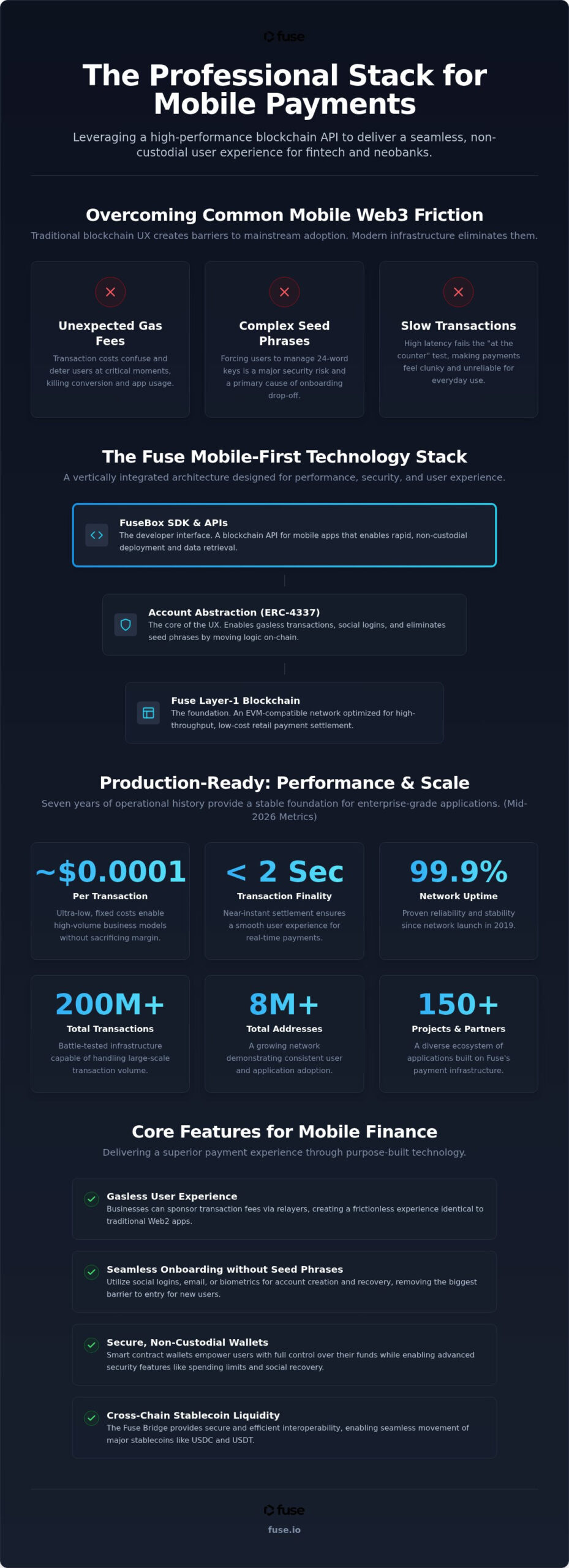
You’ve likely felt the frustration of watching potential users drop off during onboarding. It’s time to demand more from your infrastructure. This guide teaches you how to integrate professional-grade payment rails that deliver sub-2 second transaction finality and a gasless user experience. We’ll show you how to leverage FuseBox and account abstraction (ERC-4337) to deploy seamless, non-custodial stablecoin payments. With a track record dating back to 2019 and over 200 million transactions processed at $0.0001 each, the architecture is ready. Let’s bridge the gap between complex systems and high-performance mobile interfaces.
Key Takeaways
- Modern blockchain interfaces have evolved from simple data tools into high-performance transactional rails for mobile finance.
- Account abstraction (ERC-4337) is essential for removing seed phrases and enabling gasless user experiences.
- Successful scaling requires sub-2 second transaction finality and costs maintained at approximately $0.0001.
- Integrate a professional-grade blockchain api for mobile apps via the FuseBox SDK for rapid non-custodial deployment.
- Secure cross-chain liquidity for USDC and USDT by leveraging the interoperability of the Fuse Bridge.
What is a Blockchain API for Mobile Apps?
A blockchain API for mobile apps serves as the critical bridge between a mobile frontend and a decentralized ledger. It acts as a translator. It converts complex cryptographic data into a format your application can display to a user. In the early days, these interfaces were limited to basic data querying. Today, they’ve evolved into high-performance transactional infrastructure. They handle the rails of digital finance. To understand the underlying structure, you can explore the basics of What is Blockchain Technology and its role in decentralized security.
Traditional Web3 APIs often fail the mobile UX test because they weren’t built for speed. High latency and complex signing flows kill user retention. A professional-grade blockchain api for mobile apps must prioritize sub-2 second finality. It has to feel like a standard banking app. EVM-compatible infrastructure is vital. It gives developers the flexibility to use established libraries while tapping into the performance of specialized Layer-1 networks. This compatibility reduces development time. It ensures your app can scale as transaction volume grows.
Types of Blockchain Interfaces: APIs vs. SDKs
REST APIs are perfect for simple data retrieval. They fetch transaction histories, token balances, and network status updates. They’re lightweight and fast for read operations. However, mobile apps need more than just data. They need to sign transactions securely on the device. This is where mobile SDKs come in. An SDK provides the tools for secure private key management and non-custodial security. A production-ready stack combines both. You use the API to pull data and the SDK to authorize movements. This dual approach ensures your app remains responsive while maintaining bank-grade security standards.
The Evolution of Mobile Web3 Connectivity
Connectivity has shifted from external wallet connections to fully embedded finance. Users used to rely on WalletConnect to link their apps to a separate wallet. That friction is now unacceptable. Neobanking apps now demand invisible blockchain features. This requires account abstraction (ERC-4337) to remove the need for seed phrases. The goal is a gasless user experience where the blockchain operates in the background. Look at the Mystic Valley case study. They integrated blockchain ticketing for a massive festival. Attendees didn’t need to learn about crypto. They just used their tickets. The infrastructure handled the rest. This is the new standard for mobile payments: complex tech hidden behind a simple, high-performance interface.
Core Components of a Mobile-First Blockchain Stack
Building a high-performance payment app requires more than just a blockchain api for mobile apps. It requires a vertically integrated stack designed to remove technical friction. You can’t rely on general-purpose networks that prioritize complex smart contracts over payment speed. A mobile-first architecture consists of four critical layers: the Layer-1 network, account abstraction (ERC-4337), relayers, and smart contract wallets. Each component must work in sync to deliver a professional user experience.
The Layer-1 network is your foundational ledger. It’s where transactions are settled and secured. For retail payments, this network must be optimized for high throughput. The Fuse Network has maintained a 99.9% uptime since 2019, processing over 200 million total transactions. This level of stability is essential for fintechs that can’t afford downtime. Smart contract wallets move the account logic on-chain. Unlike traditional wallets that live only on a device, these programmable accounts allow for advanced security features and social recovery. Relayers sit between the app and the network, handling the submission of transactions and enabling the backend to sponsor fees.
The Role of Account Abstraction (ERC-4337)
Account abstraction (ERC-4337) is the standard that makes blockchain invisible to the end user. It’s the key to removing 24-word seed phrases. In 2026, forcing a user to manage a private key is a guaranteed way to kill your conversion rate. ERC-4337 allows you to implement social logins and biometric authentication. It also enables gasless transactions. This means your business can pay the network fees on behalf of the user, creating a familiar Web2-like experience. Batching transactions is another advantage. It allows users to approve and execute multiple actions in a single click, which is vital for reducing friction during mobile checkouts.
Infrastructure for Last-Mile Payments
EVM-compatibility is the industry standard for developer flexibility. It ensures your team can use established tools while integrating with a specialized blockchain api for mobile apps. Retail payment acceptance demands sub-2 second finality. If a user has to wait at a checkout for a block to confirm, the app has failed. Integrating non-custodial wallet APIs ensures that users retain control of their funds, which simplifies compliance and enhances trust. You can explore how these components integrate into a production-ready payment stack to accelerate your time-to-market. High-performance rails are no longer an experiment; they are a requirement for any business adopting stablecoin payments at scale.
Evaluating Blockchain APIs: Performance and Cost Metrics
Choosing a blockchain api for mobile apps isn’t about checking boxes. It’s about stress-testing infrastructure. You need an API that supports 25,000 daily transactions without breaking a sweat. Throughput is just the start. Uptime is the ultimate trust signal. The Fuse mainnet has operated with 99.9% uptime for seven years. This isn’t a beta test. It’s a production-ready environment that has handled over 200 million transactions since 2019. If your API provider can’t show a multi-year track record of stability, your app’s reputation is at risk.
Don’t confuse block time with finality. A fast block time is useless if you have to wait for multiple confirmations. For retail payments, sub-2 second finality is the only metric that matters. It ensures the merchant sees the “Paid” screen before the customer puts their phone away. This speed is what separates professional payment rails from experimental protocols. When transactions settle instantly, user trust increases. When they lag, users abandon the app. It’s that simple.
Cost Analysis for Fintech Scalability
High gas fees kill margins. They make microtransactions impossible. Ethereum fees are often higher than the transaction value itself. This is the “hidden cost” that breaks neobank business models. Benchmarking shows Fuse is approximately 1000x cheaper than Ethereum for daily payments. Costs stay at ~$0.0001 per transaction. This predictability allows you to sponsor user fees without draining your treasury. For businesses that need predictable overhead, the Fuse Console offers a flat $50/month model to manage your ecosystem. It’s built for scale. It’s built for builders who value cost efficiency over hype.
Network Security and Longevity
Longevity proves security. A network with 8 million addresses and seven years of uninterrupted operation provides a level of certainty that newer chains can’t match. We use a Proof-of-Stake (PoS) consensus model. It balances energy efficiency with decentralization. Validator geographic distribution ensures there’s no single point of failure. Over 150 projects have already deployed on these rails, proving the architecture’s resilience. When you evaluate a blockchain api for mobile apps, you’re buying into the security of the underlying network. Choose the one that has already solved the hard problems. Trust the data, not the promises.
Implementation Guide: Building with Mobile SDKs
Transitioning from theoretical architecture to a live product requires a structured deployment strategy. You need a blockchain api for mobile apps that integrates directly with your existing development workflow. The process begins with selecting an EVM-compatible Layer-1 for settlement. This ensures compatibility with the widest range of developer tools. Next, you integrate the FuseBox SDK to handle wallet creation. This SDK abstracts away the complexity of key management. It allows you to focus on the application logic rather than the cryptographic plumbing.
Configuring gasless transaction relayers is the third step. This is where you remove the final barrier to entry for your users. Finally, you implement stablecoin payment flows via the API. This enables instant value transfer without the volatility of native tokens. By following these steps, you move from a concept to a production-ready application in weeks rather than months. It’s about building on stable rails that have already been tested at scale.
Deploying Embedded Wallets
Embedded wallets are the standard for 2026 mobile development. Unlike external wallet apps, these accounts live directly inside your interface. Using specialized SDKs, you can create non-custodial accounts that give users full control without the burden of seed phrases. Secure private key management is handled via mobile hardware enclaves like Apple’s Secure Enclave or Android’s StrongBox. This ensures keys never leave the device’s secure hardware. Once deployed, your app connects to the Fuse Network for real-time balance updates. Users see their funds instantly. They don’t need to understand the underlying Layer-1 architecture to benefit from its security.
Configuring Gasless Transactions
Gasless transactions are powered by paymasters. These are smart contracts that sponsor user transaction fees. You can define specific logic for fee subsidization to match your business model. For example, you might offer the first 10 transactions for free to onboard new users. This approach has been proven to reduce friction in emerging markets. Projects like Sanduk and Freedom utilize this infrastructure to make digital payments accessible to non-technical users. It turns a complex blockchain interaction into a simple button click. You can deploy your own payment rails today and start scaling your mobile ecosystem with professional-grade tools.
Scaling Mobile Payments with the Fuse Ecosystem
Scaling a payment product requires more than just a blockchain api for mobile apps. It demands a cohesive ecosystem. Fuse provides a “Full Stack” advantage by combining a purpose-built Layer-1 with professional SDKs and business management tools. This vertical integration removes the need to patch together disparate services. You get a single, stable environment for settlement, wallet management, and liquidity. It’s a ready-to-use solution for real-world financial challenges.
Interoperability is the lifeblood of global payments. The Fuse Bridge provides essential access to USDC and USDT liquidity. This ensures your mobile app can handle cross-border transfers and stablecoin payouts with ease. You aren’t building in isolation. You are tapping into an established network with 150+ projects and approximately 8 million addresses. This existing synergy accelerates growth. It provides a foundation of trust that has been growing since 2019. Case studies like Solid demonstrate this effectiveness. They built a non-custodial neobank on Fuse rails, proving that professional infrastructure can support complex, high-volume financial services.
Real-World Adoption in Emerging Markets
Stablecoin payouts are transforming commerce in SE Asia and Latin America. In these regions, the demand for instant settlement and low fees is critical. The Freedom Wallet utilizes the Fuse ecosystem to power loyalty programs and retail payments for thousands of users. This isn’t a pilot program. It’s active infrastructure. Similarly, Zneakrz enables micro-tips and e-commerce checkouts using these same payment rails. These applications benefit from ~$0.0001 transaction costs and sub-2 second finality. They provide a seamless experience that feels like a traditional bank but operates with the efficiency of a decentralized ledger.
Getting Started with Professional Infrastructure
Deploying your next project is straightforward. Access the Fuse Console to manage your project parameters and monitor network performance. Our developer documentation provides the technical blueprints for integrating a blockchain api for mobile apps into your existing stack. We’ve already solved the hard problems of latency, gas fees, and complex onboarding. Your focus should remain on building the best user experience. Stop fighting technical friction. Build your next payment app on the most efficient Layer-1 for mobile. Visit docs.fuse.io to start your integration today.
Deploy Production-Ready Payment Rails Today
Integrating a blockchain api for mobile apps is no longer a technical experiment. It’s a strategic necessity for fintechs that value speed and margin. You’ve seen how account abstraction (ERC-4337) and specialized Layer-1 infrastructure remove the friction that once defined Web3. The shift from complex seed phrases to gasless, biometric-secured payments is the new standard for 2026.
Efficiency defines the Fuse ecosystem. With over 200 million transactions processed since 2019, the network provides the stability required for enterprise integration. You can achieve sub-2 second finality for instant retail payments while maintaining an average transaction cost of $0.0001. This performance allows you to scale without sacrificing the user experience or your bottom line.
The tools are ready. The documentation is live. It’s time to move your mobile application onto the rails of the future. Build on Fuse and join a growing network of over 150 professional projects. Your users deserve the speed of modern finance.
Frequently Asked Questions
What is the best blockchain API for mobile app development?
The best blockchain api for mobile apps is one that provides vertically integrated payment rails rather than generic data querying. You need an environment optimized for low-cost, high-speed settlement. The FuseBox SDK offers this by combining account abstraction with a Layer-1 purpose-built for financial services since 2019. It removes the need to patch multiple third-party services together into a fragile stack.
How do I handle gas fees in a mobile blockchain app?
You handle gas fees by implementing gasless transactions through account abstraction (ERC-4337). This utilizes a paymaster to sponsor fees on behalf of the user. It creates a familiar Web2 experience where the user never sees a network fee. By subsidizing the ~$0.0001 cost per transaction, businesses can maintain high margins while providing a seamless, frictionless checkout flow for their customers.
Can I build a non-custodial wallet with a simple API?
Yes, building a non-custodial wallet is achievable with a professional SDK integration. You don’t need to build the cryptographic infrastructure from scratch. Mobile SDKs allow you to create embedded wallets that utilize on-device hardware enclaves for secure key storage. This ensures the user retains full control of their funds while enjoying a streamlined, social-login onboarding process that bypasses traditional seed phrases.
What is the difference between a blockchain API and a mobile SDK?
A blockchain API focuses on fetching data and submitting signed transactions to the network. A mobile SDK provides the tools to manage private keys and sign those transactions securely on the device. For a production-ready app, you need both. The SDK handles the non-custodial security logic; the API interacts with the ledger for real-time balance updates and transaction history.
How fast are blockchain transactions on mobile?
Transaction speed on mobile must match retail expectations; this means achieving sub-2 second finality. Users won’t wait for multiple block confirmations at a physical point of sale. The infrastructure must be optimized for instant settlement. Having processed over 200 million transactions since 2019, the Fuse Network provides the high-performance rails necessary for immediate payment confirmation in real-world environments.
Is it expensive to integrate blockchain into a mobile app?
Integration is cost-effective when using established infrastructure like the Fuse Console. Instead of building custom backend logic, developers use a standardized blockchain api for mobile apps to reduce time-to-market. Ongoing transaction costs stay at approximately $0.0001. This predictability is essential for fintechs managing tight margins and high daily transaction volumes across 8 million addresses.
What are the most common use cases for blockchain APIs in mobile?
Mobile blockchain use cases center on stablecoin payments and loyalty programs. Neobanks use these APIs to offer non-custodial accounts with global liquidity. Other common applications include micro-tips for content creators and e-commerce checkouts that bypass traditional card networks. These use cases rely on account abstraction to hide technical complexity and provide a familiar interface for the end user.
How do I ensure the security of a mobile blockchain integration?
Security is ensured by adopting a non-custodial architecture where the user holds their own keys. Use EVM-compatible infrastructure that has been battle-tested over several years. Implementing mobile hardware enclaves for key management adds a physical layer of security to the digital assets. This approach, combined with 99.9% network uptime, protects both user assets and the business’s operational integrity.