.svg)

.svg)


.svg)

.svg)


.svg)


%201.svg)
.svg)


%201.svg)
%20(1)%201.svg)
.svg)


.svg)
%201.svg)

Most blockchain networks claim to support the future of finance, yet they fail when tasked with processing a ten-cent payment. You’ve seen the friction points firsthand. High gas fees kill margins. Seed phrases alienate users. Slow finality destroys the product experience. It’s impossible to scale blockchain for microtransactions when the underlying infrastructure costs more than the transaction itself.
This guide demonstrates how payments-first Layer-1 architecture makes sub-cent payments a production-ready reality in 2026. You’ll discover how combining sub-two-second finality with account abstraction (ERC-4337) removes the technical barriers between your business and its users. We’ve spent seven years refining the rails for this exact moment. Our network has already processed over 200 million transactions since 2019 with a track record of 99.9% uptime.
We’ll analyze the current cost-per-transaction landscape across major chains to show where the value lies. You’ll learn how to implement gasless transactions using FuseBox to create a frictionless onboarding flow. Finally, we provide a blueprint for a payment stack that delivers transaction costs of approximately $0.0001. It’s time to move beyond theoretical scaling and deploy on infrastructure built for enterprise-grade volume.
Key Takeaways
- Identify why legacy payment rails create a “Fee Paradox” for sub-dollar payments and how blockchain for microtransactions solves this cost barrier.
- Evaluate the specific Layer-1 architecture requirements needed to achieve sub-2 second finality and transaction costs of approximately $0.0001.
- Discover how ERC-4337 account abstraction and FuseBox eliminate seed phrases to provide a seamless, gasless experience for consumer apps.
- Map out the essential “last-mile” payment stack required to integrate non-custodial stablecoin payments into existing fintech products.
- Leverage a production-ready infrastructure with a seven-year track record, 99.9% uptime, and over 200 million total transactions.
The Microtransaction Paradox: Why Traditional Rails Fail
Microtransactions are the granular fuel of the 2026 digital economy. These are low-value payments, typically under $1, powering everything from pay-per-article journalism to micro-SaaS API calls. While demand for these payments is increasing, legacy financial systems are hitting a wall. The infrastructure simply isn’t designed to handle high-frequency, low-value transfers without collapsing under its own weight.
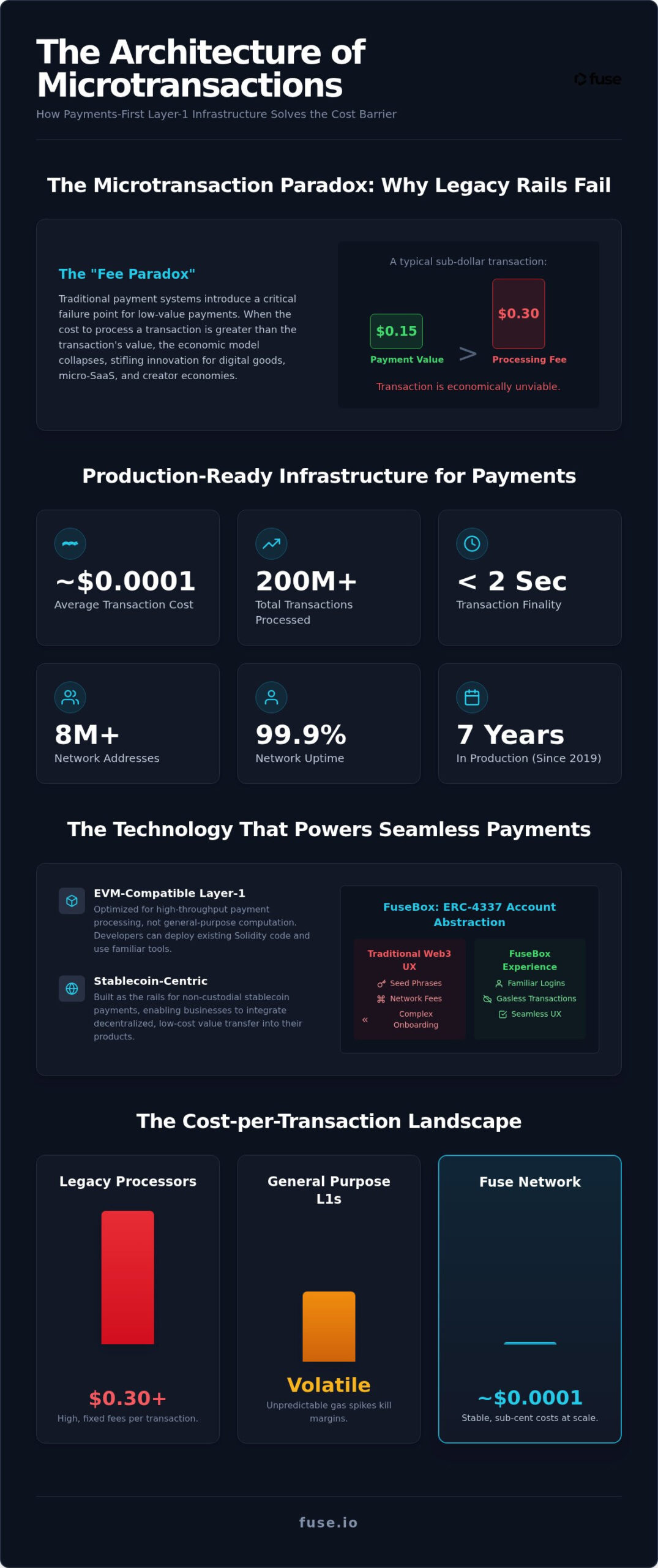
The core of the problem is the ‘Fee Paradox.’ This occurs when the cost of processing a transaction exceeds the value of the payment itself. If a creator wants to sell a digital asset for $0.15, but the payment gateway charges $0.30 plus a percentage, the transaction is dead on arrival. This economic friction has stalled innovation in fintech and neobanking for years. Legacy processors prioritize security for large transfers, but their cost structures make them irrelevant for the sub-dollar market.
Legacy payment processors in 2026 remain bogged down by intermediaries. Every hand in the pot adds a fee and a delay. This centralized model creates a bottleneck for global scale. Businesses need a decentralized, low-cost alternative that operates outside these restrictive rails. This is where blockchain technology steps in. By utilizing blockchain for microtransactions, companies can bypass traditional gatekeepers and move value with efficiency.
The Hidden Costs of Legacy Payment Infrastructure
Traditional finance thrives on fixed-fee models. A standard processor might charge $0.25 to $0.35 per transaction. On a $50 purchase, that’s negligible. On a $0.20 micro-payment, it’s a 150% tax. Beyond the immediate fees, settlement delays further handicap small vendors. Waiting days for funds to clear creates liquidity gaps that small-scale digital businesses can’t afford. There’s also the constant threat of chargeback fraud. For a vendor selling $0.10 goods, the administrative cost of a single chargeback can wipe out the profits of a thousand successful sales.
Friction as a Conversion Killer
Conversion rates live and die by user experience. Payment friction is the ultimate conversion killer in digital media and software-as-a-service. Every additional step, password, or redirect increases the likelihood of an abandoned cart. Users have a low tolerance for complexity when the price tag is minimal. They want a “one-click” experience that feels native to the app they’re using. For blockchain for microtransactions to work, the experience must be invisible. It needs to provide the security of non-custodial ownership without the technical hurdles of traditional crypto wallets. We’ve spent seven years building the Layer-1 infrastructure that makes this possible, processing over 200 million transactions to prove that scale and speed can coexist without the heavy tax of legacy rails.
How Layer-1 Blockchain Solves the Cost-Per-Transaction Barrier
Scaling micro-payments requires an economic model where the network doesn’t penalize growth. While traditional rails fail due to fixed overheads and middleman taxes, a payments-first Layer-1 provides the specific architecture needed for blockchain for microtransactions. Most general-purpose chains prioritize complex smart contract execution over simple value transfers. This leads to unpredictable gas spikes that kill business margins. By focusing on EVM-compatibility, we ensure developers can deploy existing codebases onto a network optimized for one thing: moving money at scale. This allows teams to use familiar tools while accessing a network with over 8 million registered addresses.
Achieving Sub-Cent Transaction Economics
Predictability is the foundation of any fintech business model. General-purpose chains often see fees fluctuate based on high-traffic events like NFT mints or DeFi liquidations. In contrast, a payments-first rail maintains stability. We’ve optimized our network to achieve transaction costs of approximately $0.0001. This isn’t a theoretical goal; it’s a production-ready metric. For high-frequency apps, this cost structure changes everything. It allows for micro-tipping, pay-per-view content, and automated stablecoin payments that were previously impossible. Businesses can finally stop subsidizing high network fees and start focusing on user growth.
Network Finality and High Throughput
User experience is defined by speed. Sub-2 second finality is critical for consumer-facing applications where latency equals abandonment. If a payment takes ten seconds to confirm, the user flow is broken. Our infrastructure manages over 25,000 daily transactions with 99.9% uptime, ensuring that high volume doesn’t lead to congestion. This performance is backed by a seven-year track record and over 200 million total transactions processed since our mainnet went live in 2019. With over 150 projects already integrated, the ecosystem provides a stable environment for neobanks evaluating infrastructure. These metrics represent the stability required for serious enterprise integration. You can explore our network architecture to see how we bridge the gap between technical scalability and real-world utility.
Account Abstraction: The Key to Web2-Like Micro-Payments
ERC-4337 account abstraction is the definitive UX standard in 2026. It transforms the user experience by turning accounts into programmable smart contracts. This shift is essential for blockchain for microtransactions because it removes the manual overhead of managing network-specific gas tokens. Users don’t need to calculate gwei or keep a balance of native tokens just to pay for a ten-cent digital asset. Instead, the complexity is abstracted away. This creates an “Invisible Blockchain” experience where the technology works silently in the background. It allows consumer apps to focus on utility rather than technical education.
Eliminating the Gas Fee Hurdle
Gas fees are a psychological barrier. For micro-payments, asking a user to pay any network fee is a conversion killer. Developers can now use paymasters to sponsor these costs entirely. This enables a gasless transaction model where the end-user sees a $0.00 fee at checkout. Research into scaling sub-cent payments shows that removing this friction significantly boosts long-term user retention. By handling complex fee logic behind the scenes, businesses can offer a Web2-like experience while maintaining the efficiency of decentralized settlement. Since our transaction costs average $0.0001, sponsoring millions of transactions becomes a viable marketing expense rather than a budget drain.
Smart Wallets and Non-Custodial Security
Onboarding shouldn’t require a master’s degree in cryptography. Smart contract wallets eliminate seed phrases. They replace them with social logins and biometric recovery. By integrating non-custodial wallet APIs, developers can build apps that look and feel like standard mobile banking. This “tap-and-pay” simplicity doesn’t compromise security. It leverages non-custodial architecture, ensuring users retain control of their assets without the risk of losing a 12-word recovery phrase. We’ve seen this model work at scale across 8 million addresses. It proves that high security and extreme ease of use aren’t mutually exclusive. This is the production-ready infrastructure needed for mass-market adoption in the neobanking sector. The result is a payment rail that is secure, scalable, and entirely frictionless for the modern consumer.
Strategic Implementation for Fintechs and Consumer Apps
Scaling a payment product requires more than just a fast network. It demands a robust “Last-Mile” payment stack. This consists of three core components: a stable Layer-1 chain, a comprehensive API, and a mobile-first SDK. For fintechs and neobanks, the goal is to integrate blockchain for microtransactions without rebuilding their entire backend. You need a production-ready environment that supports millions of on-chain tasks with zero downtime. This infrastructure must handle everything from identity management to final settlement while keeping costs at approximately $0.0001 per transaction.
Choosing the Right Layer-1 for Payments
Don’t build on experimental rails. Reliability is your primary metric. A network with a 99.9% uptime record and a history dating back to 2019 provides the stability enterprise partners expect. While general-purpose L2s are popular, they often introduce complexity through centralized sequencers or unpredictable fee markets. A dedicated Network purpose-built for payments offers the predictable throughput needed for 25,000 daily transactions. Interoperability is also a requirement. You need high-performance bridges to move liquidity across chains. This ensures your stablecoin payments remain liquid and accessible across the broader EVM ecosystem.
Implementation follows a clear roadmap. First, select an EVM-compatible chain to ensure developer familiarity. Second, leverage a centralized dashboard like the Fuse Console to manage your project’s API keys and monitoring. Third, deploy your smart contract wallets. Finally, integrate stablecoin payment rails to settle transactions in real-time. This structured approach reduces technical debt and accelerates your launch. By choosing a veteran infrastructure, you gain access to a seven-year track record and an ecosystem that has already processed over 200 million total transactions.
Building with Mobile-First SDKs
Speed is a competitive advantage. Building a non-custodial wallet from scratch is a multi-month engineering effort. Instead, use pre-built wallet infrastructure to bridge the gap between on-chain workflows and Web2 mobile interfaces. By using FuseBox, you can implement account abstraction immediately. This allows your users to interact with the blockchain through familiar social logins or biometrics. The underlying technology remains non-custodial, but the user experience is indistinguishable from a standard banking app. This modular approach lets your team focus on the user interface while the infrastructure handles the heavy lifting of secure, sub-cent settlement.
Security best practices are non-negotiable when managing millions of small transactions. A non-custodial model ensures that you aren’t a target for large-scale hacks, as users retain control of their assets. Our network has already secured 8 million addresses using this architecture. It’s a battle-tested blueprint for global scale. To begin your integration, you can explore our developer resources and start building on a rail designed for the next billion users.
Scaling Microtransactions on the Fuse Network Infrastructure
Theoretical scalability is common in the blockchain sector, but execution at scale is rare. For blockchain for microtransactions to move from a developer’s sandbox to a global neobank, the underlying rails must be battle-tested. We’ve spent seven years refining a payments-purpose-built Layer-1 that prioritizes immediate utility over experimental complexity. Since our mainnet went live in 2019, the network has maintained 99.9% uptime while processing a milestone of over 200 million total transactions. This isn’t just a performance metric; it’s a demonstration of a stable, production-ready environment for enterprise-grade volume.
A Proven Payments Ecosystem Since 2019
Veteran infrastructure matters because financial products cannot afford the “move fast and break things” mentality. With a seven-year track record, our network provides the reliability required for last-mile settlement. We currently support over 150 projects and approximately 8 million unique addresses. This ecosystem handles 25,000 daily transactions with sub-2 second finality, ensuring that micro-payments happen in real-time. For businesses adopting stablecoin payments, this history offers a level of technical credibility that newer, unproven chains cannot match. You aren’t just deploying on a blockchain; you’re integrating into a mature network architecture designed specifically for the movement of value.
Efficiency increases when the technology stack is vertically integrated. We provide the full range of tools needed to manage a decentralized payment business. This includes the Layer-1 blockchain for settlement, FuseBox for account abstraction (ERC-4337), and the Fuse Console for backend management. For a $50 flat-rate monthly fee, businesses gain a centralized dashboard to monitor network activity, manage API keys, and scale their operations. This predictable pricing model allows neobanks to forecast their operational costs without worrying about fluctuating infrastructure taxes. It’s the definitive stack for anyone building blockchain for microtransactions in 2026.
Real-World Case Studies: Micro-Payments in Action
The effectiveness of our infrastructure is best seen through the success of the projects built upon it. These case studies demonstrate how our “rails” enable specific business models that legacy systems often reject. Each project utilizes our core stack to remove friction and reduce costs to approximately $0.0001 per transaction.
- Zneakrz: This project utilizes our rails to enable frictionless tips and small-scale e-commerce payments. By leveraging gasless transactions, they ensure that the user experience remains focused on the product rather than the payment process.
- Sanduk: Focused on emerging markets, Sanduk provides stablecoin payout infrastructure. Their model relies on our low-cost settlement to move small amounts of value across borders with sub-2 second finality.
- Mystic Valley: This case study highlights consumer-scale ticketing and rewards. They manage thousands of micro-interactions, proving that high-frequency on-chain tasks can be handled without network congestion.
These examples confirm that the Fuse ecosystem is the stable foundation for professional and enterprise integration. We’ve solved the hard problems of cost and complexity so you don’t have to. The future of micro-payments is already live, and it’s running on a veteran infrastructure built for scale.
Deploy the Future of Micro-Payments
Legacy financial systems cannot compete with the efficiency of purpose-built decentralized rails. We’ve established that success in 2026 requires a payments-first Layer-1 architecture combined with ERC-4337 account abstraction. This specific stack eliminates the “Fee Paradox” and removes the technical friction that once made sub-dollar payments impossible. By abstracting gas fees and simplifying onboarding, businesses can finally deliver a Web2-like experience on non-custodial infrastructure.
Scaling blockchain for microtransactions is no longer a theoretical challenge. It’s a logistical deployment on veteran infrastructure. Our network offers a seven-year track record of 99.9% mainnet uptime and has already processed over 200 million transactions. With sub-2 second finality and transaction costs of approximately $0.0001, the rails are ready for enterprise-grade volume and global reach. The hard problems of scalability and user experience have already been solved.
Don’t let legacy bottlenecks stall your product roadmap. It’s time to move your payment workflows onto a stable, production-ready environment designed for the next billion users. Build Scalable Micro-Payments on Fuse and join an ecosystem of over 150 projects already redefining digital finance. The tools are here. The network is stable. It’s time to build.
Frequently Asked Questions
What is a microtransaction in the context of blockchain?
Microtransactions are low-value digital payments, typically under $1, that require instant settlement. On a decentralized network, they represent the ability to move small amounts of value securely without intermediaries taking a significant cut. Utilizing blockchain for microtransactions allows businesses to bypass the 30-cent minimum fees often enforced by legacy credit card networks. This enables new monetization models like pay-per-content or micro-tipping that were previously economically unviable.
Why is Ethereum too expensive for microtransactions?
Ethereum prioritizes high-value security, which creates intense competition for limited block space and drives up gas fees. This competition often pushes transaction costs higher than the value of a micro-payment itself. Even with Layer-2 scaling, median fees remain too volatile for sub-cent business models. High-frequency apps require a dedicated payment rail that maintains cost stability regardless of the activity on general-purpose smart contract platforms.
How do gasless transactions work for micro-payments?
Gasless transactions use paymasters to sponsor network fees on behalf of the user. Developers integrate this logic so the end-user pays nothing for the transaction, while the business covers the sub-cent cost as an operational expense. This is a critical component of blockchain for microtransactions because it removes the technical barrier of requiring users to hold native tokens. It creates a frictionless experience that mirrors traditional mobile apps.
Can I process microtransactions with stablecoins like USDC?
Yes, stablecoin payments are a standard feature on EVM-compatible payment rails. You can use assets like USDC or USDT to ensure price stability for both the sender and the receiver. This allows neobanks to offer digital dollar accounts where users can send sub-cent amounts without exposure to the volatility of native network tokens. It provides the familiarity of fiat currency with the efficiency of decentralized settlement.
What is the cheapest blockchain for microtransactions in 2026?
A payments-purpose-built Layer-1 provides the most cost-effective infrastructure for small payments. In 2026, networks optimized specifically for value transfer achieve costs of approximately $0.0001 per transaction. This efficiency is maintained through a seven-year track record of 99.9% uptime. These rails enable businesses to scale to millions of transactions without the high overhead or congestion-based fee spikes found on general-purpose blockchains.
Do users need to know they are using blockchain for small payments?
No, modern infrastructure allows for an “Invisible Blockchain” user experience. By utilizing account abstraction, users can sign up using social logins or biometrics instead of managing complex private keys. The blockchain functions as a high-speed settlement layer in the background. The end-user interacts with a high-performance interface that feels indistinguishable from a standard Web2 banking or fintech application.
How does account abstraction improve microtransaction UX?
Account abstraction (ERC-4337) converts standard accounts into programmable smart contracts. This shift enables features like social recovery, multi-signature security, and sponsored transactions. It eliminates the need for 12-word seed phrases, which are the primary cause of user drop-off in decentralized apps. For micro-payments, it provides the “tap-and-pay” convenience necessary for mass-market consumer adoption and high-frequency use.
What is the typical transaction cost on the Fuse Network?
The typical transaction cost on our network is approximately $0.0001. This predictable pricing is supported by a history dating back to 2019 and over 200 million total transactions processed. We maintain these sub-cent costs by providing a dedicated infrastructure that avoids the fee spikes common on general-purpose networks. This makes it a stable, production-ready rail for enterprises managing high-volume payment workflows.