.svg)

.svg)


.svg)

.svg)


.svg)


%201.svg)
.svg)


%201.svg)
%20(1)%201.svg)
.svg)


.svg)
%201.svg)

Defining Embedded Web3 Financial Services in the 2026 Economy
Embedded Web3 financial services represent a fundamental infrastructure shift. It is the integration of decentralized, on-chain financial primitives—payments, lending, and value exchange—directly into non-financial applications and platforms. This model moves beyond the traditional API-driven approach of Banking-as-a-Service (BaaS) by leveraging public blockchain networks as the core settlement and logic layer.
By 2026, the market has matured past the initial phase of “destination banking,” where users had to visit a separate banking app to manage finances. We are now in the era of “contextual finance.” Consumers and businesses expect financial capabilities to be present at the point of need, whether paying a supplier within an ERP system, splitting a bill inside a social app, or receiving instant payouts on a freelance platform. This expectation is driven by a demand for speed, lower costs, and a seamless user experience that legacy financial systems struggle to provide.
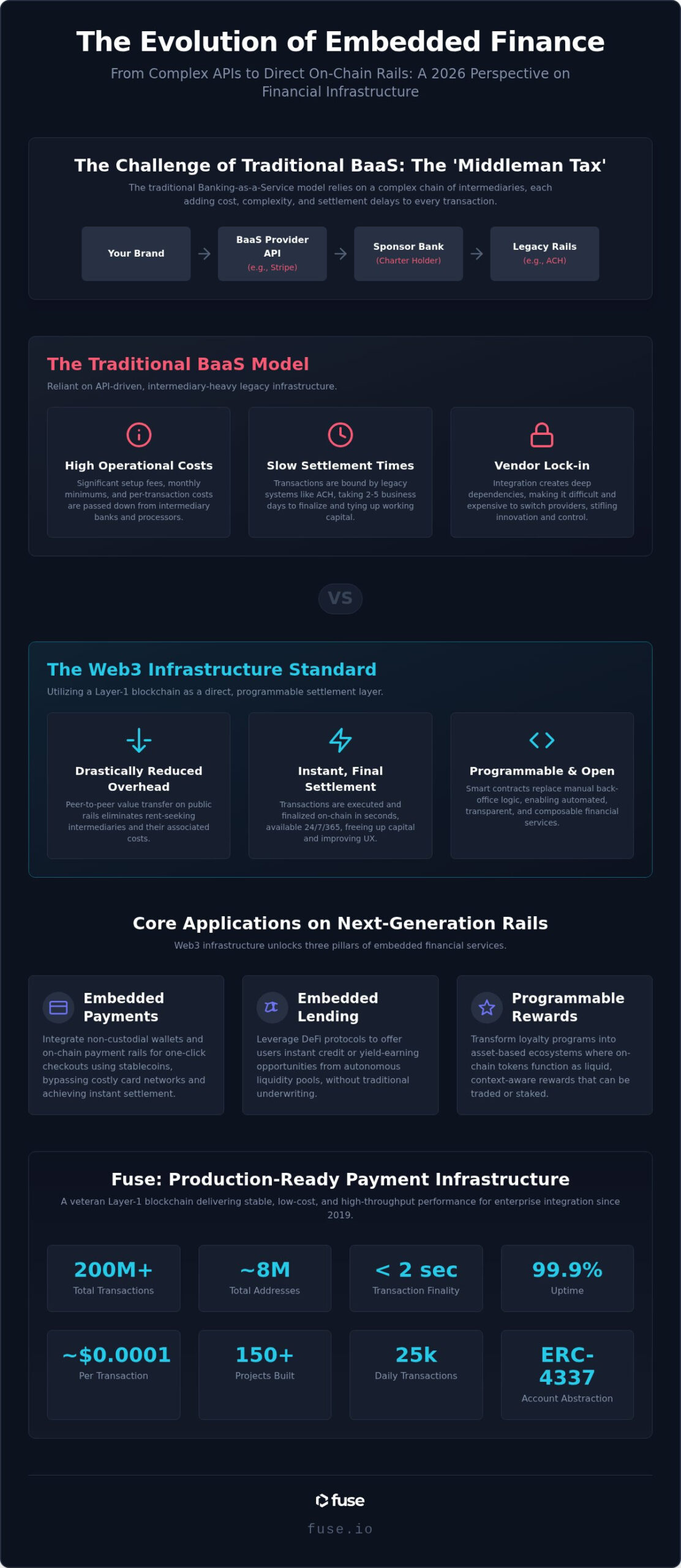
The core distinction between traditional fintech and Web3-native embedded models lies in the infrastructure. Traditional models rely on a complex, expensive stack of intermediary banks, processors, and BaaS providers. A Web3 model, by contrast, utilizes a Layer-1 blockchain as a single, programmable rail for settlement and execution, drastically reducing overhead and counterparty risk.
The Three Pillars: Payments, Lending, and Programmable Rewards
The applications of embedded Web3 finance are built upon three core functionalities that can be programmatically integrated into any digital experience:
- Embedded Payments: This is the most immediate use case. It involves integrating non-custodial wallets and on-chain payment rails directly into an app. For users, this means one-click checkouts using stablecoins or other digital assets. For businesses, it means bypassing costly card networks and receiving instant, final settlement.
- Embedded Lending: Decentralized finance (DeFi) protocols allow for the creation of autonomous liquidity pools and lending markets. Embedded within a platform, these can offer users instant credit or yield-earning opportunities based on their on-chain activity, without the need for traditional credit underwriting.
- Programmable Rewards: Loyalty programs are transformed from liability-heavy points systems into dynamic, asset-based ecosystems. On-chain tokens can function as liquid, context-aware rewards that can be traded, staked, or used for governance, creating a more engaged user base.
Market Drivers: Why Every Company is Now a Web3 Company
The adoption of embedded Web3 infrastructure is not a niche trend; it’s a strategic business decision driven by clear market advantages. Businesses are integrating these services to gain a competitive edge in three key areas:
- Increased Customer Retention: By embedding financial services, platforms create a stickier ecosystem. A frictionless, branded payment and rewards experience keeps users within the application, increasing engagement and lifetime value.
- New Revenue Streams: The high margins of financial services are now accessible without becoming a bank. Companies can move beyond simple subscription models to transaction-based monetization, earning a small fee on every payment or swap processed through their platform.
- The Role of Data: On-chain transaction history provides a transparent, verifiable record of user behavior. This data can be used to drive highly personalized product offerings, from tailored insurance products to just-in-time credit, all while respecting user privacy through decentralized identity solutions.
The Anatomy of Embedded Finance: APIs vs. On-Chain Rails
The transition to embedded Web3 finance is best understood as an evolution of the underlying infrastructure, or “rails,” upon which financial services are built. For years, Application Programming Interfaces (APIs) were the only viable method for a non-financial company to offer banking products. Today, public blockchains offer a more direct, efficient, and programmable alternative.
The traditional stack is a layered system of dependencies. A brand connects via an API to a BaaS provider like Stripe or Marqeta. That provider, in turn, connects to a sponsor bank that holds the necessary charter. This chain of intermediaries adds cost, complexity, and settlement delays to every transaction. The Web3 evolution replaces this entire stack with a single Layer-1 blockchain as the primary settlement layer. Smart contracts—self-executing code on the blockchain—replace the manual back-office logic and contractual agreements that govern traditional finance, enabling programmable money that is automated, transparent, and available 24/7.
This architectural shift directly addresses the “Middleman Tax”—the collection of fees, delays, and operational overhead imposed by the intermediaries in the traditional BaaS model. By enabling peer-to-peer value transfer on public rails, embedded Web3 services eliminate these rent-seeking layers.
The Challenges of the Traditional BaaS Model
While Banking-as-a-Service was a critical innovation, its reliance on legacy infrastructure creates significant friction for modern businesses, particularly those operating at scale or in emerging markets:
- High Setup and Operational Costs: BaaS providers charge significant setup fees, monthly minimums, and per-transaction costs. These expenses are passed down from their own sponsor bank relationships and technology overhead, making it difficult to support low-margin or microtransaction-based business models.
- Slow Settlement Times: Transactions are still bound by the timelines of legacy systems like ACH, which can take days to finalize. This ties up working capital and creates a poor user experience, especially for use cases like instant gig worker payouts.
- Regulatory Hurdles and Vendor Lock-in: Integrating with a BaaS provider means inheriting their regulatory framework and compliance stack. This creates a dependency that is difficult and expensive to switch from, leading to vendor lock-in and a lack of control over a critical part of the product experience.
Web3 Infrastructure: The New Standard for 2026
Layer-1 blockchains purpose-built for payments provide a robust and production-ready alternative to the BaaS model. This new infrastructure standard offers distinct advantages for developers and businesses building the next generation of financial applications.
- Decentralized Rails: A public Layer-1 network like Fuse Network operates continuously, offering instant and final settlement around the clock. With a track record of 99.9% uptime since its launch in 2019, it provides the reliability required for enterprise-grade financial services.
- EVM Compatibility: The Ethereum Virtual Machine (EVM) is the most widely adopted standard for smart contracts. EVM-compatible chains like Fuse allow developers to use familiar tools and languages like Solidity, dramatically reducing the learning curve and enabling them to bridge existing applications and assets from the broader Ethereum ecosystem.
- Non-Custodial Wallets: Modern Web3 SDKs enable the integration of non-custodial wallets directly into mobile and web apps. This architecture gives users full control over their funds, which significantly reduces the platform’s security and regulatory liability compared to traditional custodial models.
High-Impact Use Cases for Modern Consumer Apps
While the infrastructure is B2B, the most powerful applications of embedded Web3 financial services are in consumer-facing platforms. These use cases demonstrate how on-chain rails can solve real-world problems that are intractable or prohibitively expensive with traditional finance.
Businesses across various sectors are leveraging this technology to build more efficient and engaging products:
- Gig Economy Platforms: Enable instant, low-cost cross-border payouts for drivers, freelancers, and creators. With transaction costs around ~$0.0001, platforms can process thousands of payments for a fraction of the cost of wire transfers or card network fees.
- Community Commerce: Launch branded stablecoin payment systems for local economies, festivals, or university campuses. This fosters a closed-loop economy, reduces reliance on cash, and allows merchants to avoid high credit card processing fees. The Sanduk project in Kurdistan is a prime example of using Fuse infrastructure to empower local merchants.
- E-commerce Micropayments: Support new business models based on low-value transactions, such as paying per article in a news app or tipping content creators. Traditional payment rails make transactions under $1.00 economically unviable due to high flat fees.
- Next-Generation Loyalty: Create loyalty programs where rewards are on-chain tokens. These tokens can be traded on secondary markets, used to access exclusive features, or staked to earn yield, turning a simple rewards program into a dynamic, engaging micro-economy.
The Last-Mile Mobile Payment Revolution
Mobile-first applications are the primary frontier for embedded Web3 services. The smartphone is the ubiquitous financial tool for billions of people, and integrating seamless on-chain payments directly into the apps they use every day is the key to mass adoption. This goes beyond simple e-commerce to include coffee shop apps, local delivery services, and public transport systems.
The key to unlocking this market is reducing user friction. Modern wallet SDKs, particularly those leveraging account abstraction (ERC-4337), allow for the integration of non-custodial wallets secured by familiar biometrics. Users can interact with the blockchain without ever needing to manage complex seed phrases, creating an experience that is indistinguishable from a best-in-class Web2 application.
Stablecoins and Global Financial Inclusion
Stablecoins—digital assets pegged to the value of fiat currencies like the US Dollar—are the killer app for embedded Web3 finance. They provide the price stability of traditional currency with the efficiency and programmability of a crypto asset. For businesses, this means:
- Frictionless Cross-Border Commerce: Use stablecoins to facilitate payments and remittances globally without incurring high foreign exchange (FX) fees or multi-day settlement delays. A payment can be sent from Europe to Southeast Asia and settle in under two seconds.
- Reaching the Unbanked: In many parts of the world, mobile phone penetration far exceeds access to traditional banking. Mobile blockchain apps powered by stablecoins can provide essential financial services—saving, sending, and receiving money—to populations that have been excluded from the legacy system.
- Real-World Proof: Projects like Freedom Wallet have used Fuse Network to build and scale mobile payment solutions, demonstrating the power of this technology to create tangible economic impact in underserved communities.
Overcoming Implementation Friction: Cost and Complexity
Despite its advantages, integrating Web3 infrastructure presents perceived challenges for businesses accustomed to traditional systems. The primary objections revolve around cost, complexity, and security. However, mature Layer-1 ecosystems have developed solutions to systematically address these points of friction.
The hidden costs of traditional financial intermediaries—from interchange fees to treasury management overhead—often far exceed the transparent, predictable costs of on-chain transactions. The core challenge in Web3 has historically been the “Gas Fee” problem, where end-users are required to hold a network’s native token to pay for transaction costs. Modern infrastructure solves this through gasless transactions, where the application developer can sponsor these fees on behalf of their users, creating a completely seamless experience.
On security and compliance, the decentralized nature of public blockchains offers a different but robust model. Using non-custodial wallets shifts the burden of securing user funds from the platform to the user, managed through secure, abstracted interfaces. Smart contract audits and battle-tested code libraries provide a high degree of security, while the transparent nature of the blockchain simplifies compliance and reporting.
Finally, the user onboarding challenge is being solved by account abstraction. The need for users to learn about seed phrases and private key management was the single biggest barrier to mainstream adoption. By enabling Web2-style social logins and account recovery, platforms can onboard users without any crypto-native knowledge required.
Deploying Embedded Finance with Fuse: The Future-Ready Stack
For businesses and developers looking to build on production-ready Web3 rails, Fuse provides a complete, vertically integrated stack designed for high-performance, low-cost financial applications. With a network that has been live and stable since 2019, processing over 200 million transactions for nearly 8 million addresses, Fuse is not an experiment. It is proven infrastructure.
The ecosystem is built on several core components that work together to enable rapid deployment of embedded financial features:
- Fuse Network: The foundation is a fast, low-cost, EVM-compatible Layer-1 blockchain. With sub-2 second finality and transaction costs of approximately $0.0001, it is purpose-built for the high-throughput demands of consumer payment applications.
- FuseBox: The developer toolkit for launching branded financial features. FuseBox leverages account abstraction (ERC-4337) to allow businesses to easily integrate smart, non-custodial wallets into their applications, enabling features like gasless transactions and social logins.
- Fuse Console: An operational dashboard that allows developers and businesses to deploy, manage, and monitor their smart contracts and on-chain assets on the Fuse Network with ease.
- Fuse Bridge: A critical piece of infrastructure providing interoperability between Fuse and other major blockchain ecosystems, allowing for the seamless transfer of assets and data across chains.
Building Your Branded Wallet in Minutes
The journey to embedding Web3 finance begins with the wallet. Using FuseBox, developers can integrate a non-custodial, smart wallet experience directly into any mobile or web application. This is not a generic, third-party wallet; it is a fully customizable component that can be branded to match the look and feel of the host application.
This integration allows for the creation of branded tokens for rewards, stablecoins for payments, and other custom digital assets. By leveraging built-in relayers, businesses can sponsor transaction fees, offering their users a completely gasless experience. This removes the final point of friction, making an on-chain transaction feel as simple as a traditional digital payment.
Operational Control and Interoperability
Beyond the initial integration, businesses require tools for ongoing management and scaling. The Fuse Console provides a clear, intuitive interface for overseeing on-chain operations. From here, teams can manage smart contract deployments, monitor transaction volume, and handle treasury operations without needing deep blockchain expertise.
Furthermore, in the multi-chain world of 2026, no network can exist in isolation. The Fuse Bridge ensures that applications built on Fuse are not siloed. It enables seamless asset transfers to and from other major EVM chains, providing liquidity and connecting the Fuse ecosystem to the broader world of decentralized finance. This combination of an efficient L1, advanced developer tools, and robust interoperability makes for a truly future-ready stack.
FAQs
- What is the difference between BaaS and embedded Web3 financial services?
- BaaS relies on a stack of traditional intermediaries (sponsor banks, API providers) to connect a brand to legacy financial rails, resulting in high costs and slow settlement. Embedded Web3 services use a public blockchain as a single, direct rail for settlement, eliminating intermediaries and reducing cost and friction.
- How much does it cost to implement embedded finance on a blockchain?
- While development costs vary, the ongoing transaction costs on an efficient Layer-1 like Fuse are extremely low, approximately $0.0001 per transaction. This is orders of magnitude cheaper than the percentage-based fees charged by credit card networks and many BaaS providers.
- Is embedded finance only for large retailers and banks?
- No. The low cost and open-source nature of Web3 infrastructure make it accessible to businesses of all sizes, from startups to enterprises. It is particularly effective for SMEs, community projects, and gig economy platforms that cannot afford the high fees of traditional systems.
- What are the regulatory requirements for embedded finance in 2026?
- Regulatory landscapes vary by jurisdiction. However, a key advantage of the Web3 model is the use of non-custodial wallets, where the user maintains control of their own assets. This can significantly reduce a platform’s regulatory burden compared to custodial models where the business holds funds on behalf of users.
- How does blockchain improve embedded finance applications?
- Blockchain provides three main improvements: cost reduction (by removing intermediaries), speed (near-instant settlement 24/7), and programmability (enabling automated financial logic via smart contracts). It also offers transparency and user control over assets.
- Can I use embedded finance for micro-payments?
- Yes. This is a primary strength of using efficient Layer-1 blockchains. The low, flat transaction fees make it economically viable to process payments of any size, including those less than a dollar, which is not possible with traditional payment rails.
- What is an embedded wallet in a Web3 context?
- An embedded wallet is a non-custodial crypto wallet integrated directly into a non-financial application via an SDK. Modern embedded wallets use account abstraction (ERC-4337) to offer a user experience similar to Web2 apps, with features like social logins and gasless transactions.
- What is account abstraction and why does it matter for embedded finance?
- Account abstraction (ERC-4337) is a technical standard that allows user accounts on the blockchain to be controlled by smart contract logic instead of a single private key. This matters because it enables crucial user experience features like social login, account recovery, and sponsored (gasless) transactions, which are essential for onboarding mainstream users to Web3 applications.