

.svg)

.svg)


.svg)

.svg)


.svg)


%201.svg)
.svg)


%201.svg)
%20(1)%201.svg)
.svg)


.svg)
%201.svg)
Why Solid gives every user a bank account they actually own, and where Fuse takes it next.
Crypto has spent fifteen years building rails and almost no time building accounts.
We have faster blocks, cheaper fees, dozens of L2s and a few hundred billion dollars of stablecoins. Roughly half a billion people hold some crypto. Almost none of them bank on it. They hold a wallet, not an account, and the difference is the whole problem.
A wallet has a seed phrase, a gas balance to worry about, no card, no account number and no yield unless you go hunting for it in complex DeFi protocols. A bank account has none of those problems and one big one: someone else owns it.
The blockchain account has existed for years. What did not exist was a way to run it at scale without friction. Account abstraction, passkeys and the leap in AI-assisted tooling changed that. Only now can a self-custodied account be handed to someone who has never heard the word “wallet” and simply work.
So the missing link for mainstream adoption is not another rail. It is giving every user a smart account that functions as a bank account, one they hold the keys to, on infrastructure that minimises how much they have to trust anyone. Once millions of people have one, everything else in this industry finally has somewhere to land.
That is what we are building Fuse for. Solid is the first demonstration that it works.
1. A smart account is, functionally, a bank account
Strip a bank account down to what it does: it holds a balance, receives money, sends money, pays at a merchant, earns something, lets you borrow against what you have and, if you’re lucky, lets you buy a share of Apple.
Every one of those functions is now available to a smart contract account on Fuse, and the person using it never sees a seed phrase, a gas fee or any crypto jargon.
We know this because Solid runs on exactly that. A person in Berlin, Dhaka or Bangkok opens the app, verifies their identity, and a few minutes later has:
- a dollar account with its own account and routing numbers,
- a Visa card in Apple Pay and Google Pay,
- a balance earning up to 6% in USDC,
- 3 to 5% cashback paid in dollars that itself earns yield,
- and, shortly, Apple, Tesla, NVIDIA and the S&P 500 sitting in the same balance and trading 24 hours a day, five days a week.
All of it sits in a smart account only the user controls. Solid is a window onto that account the way a bank’s app is a window onto its ledger. The difference is who holds the keys, and that the ledger is public.
This is what consumer adoption of this technology actually looks like: everything in dollars, everything on your phone, none of the complexity. It is not a crypto app with fiat features bolted on. It is a bank whose core ledger is a blockchain, and whose customers own their accounts.
Solid is live today in more than 100 countries, with local deposits in 16 currencies. The people opening these accounts are not only crypto people. They are people who wanted a better bank account and got one.
2. Why the account has to live on a chain we own
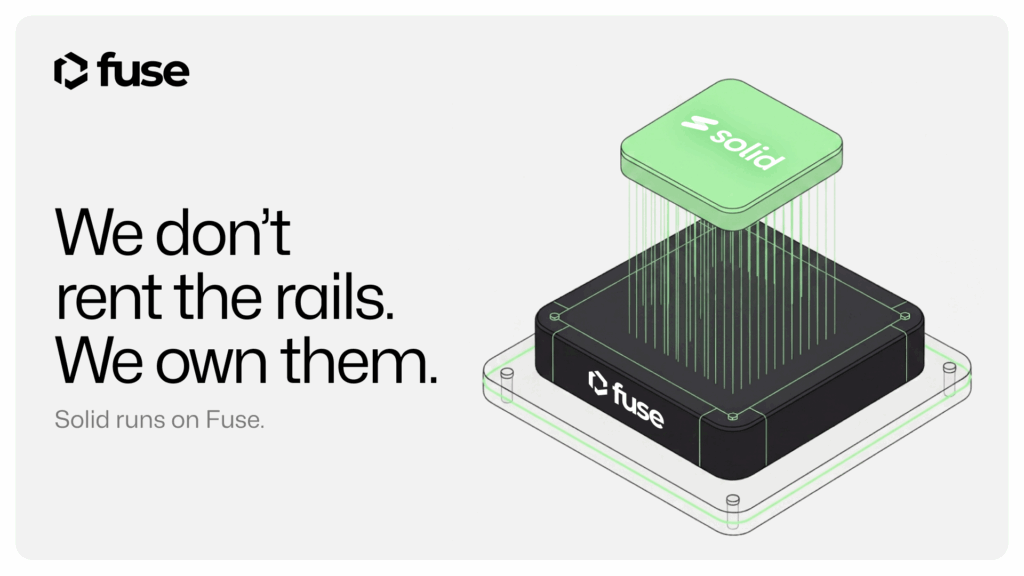
A wallet can live anywhere. An account that people trust with their salary cannot.
An account needs recovery without a seed phrase. It needs spending limits and card controls. It needs to never run out of gas, because nobody’s bank account has ever refused a payment for lack of a second currency. It needs transactions that clear in the time a card terminal waits. It needs a compliant lane for assets like tokenised equities that carry issuer restrictions, and an open lane for everything else. And it needs all of that at a cost that makes an $8 coffee sensible to settle onchain.
Those are chain-level properties, not app features. On Fuse they are native: smart accounts via Safe with passkey login through Turnkey, sponsored gas through a paymaster so the account never holds a token it doesn’t understand, sub-two-second finality, fees of a fraction of a cent, and wholesale gas pricing for the products that run on top.
Not every app needs its own chain. But not every app can build what a bank account needs on a general-purpose one either. A team shipping this product on a general-purpose chain has to rebuild every one of those pieces itself: the recovery flow, the paymaster, the limits, the compliance lane. Then it pays retail for blockspace priced by someone else’s token and governed by someone else’s roadmap, on a network designed for traders and institutions rather than for a shop taking payments.
What that team actually needs is a payments-focused chain with the tools for merchants and consumers already built in. As far as we can tell, no B2B2C payments-native chain exists today. Every alternative is an investor- or institution-facing general-purpose chain with payments as one use case among many. Fuse is built to be the exception.
This is the part of the argument that is not obvious. Everyone says they are building for real people. A bank that wants to serve real people needs to own its settlement layer, for the same reason every serious neobank eventually stops renting its core banking system. Fuse has been running payments since 2019, has settled more than 135 million transactions, and every design decision since has gone in one direction: make the chain disappear behind the account so mainstream users don’t need to learn new behaviours.
3. How millions of people come onchain, and why their businesses follow
The industry has tried to onboard businesses first for a decade. Integrate our SDK, accept our token, list on our chain. It hasn’t worked, because a business has no reason to accept money that none of its customers hold.
The systems that actually moved hundreds of millions of people onto a new financial rail, M-Pesa, Alipay, Nubank, did it the other way round. They gave the consumer an account first, made it pay better than the alternative, and the merchants followed the money. Nubank went card, then account, then investing. Robinhood went stocks, then card, then savings. Solid already has all three legs in the same account, in markets where the local bank pays two or three percent and charges five on foreign exchange.
So the sequence for Fuse is:
Accounts first. Millions of self-custodied accounts, opened because they are the best bank account available, not because anyone cares about the technology underneath.
Then the businesses those people pay and get paid by. The shop, the employer, the marketplace, the freelancer platform. Each of them gets the same primitive the consumer got: a smart account that is at once a treasury, a payment acceptor, a card issuer for its staff or customers, and a balance that earns instead of sitting idle. Cross-border payouts settle in seconds and the float earns yield instead of sitting still.
Then the agents. The next wave of payment volume will not be initiated by a person at all. Agents are starting to move real money: booking, procuring, paying for compute and data, settling between services, thousands of times a day at ticket sizes no card network was built for. That volume needs an account with programmable limits, instant settlement and near-zero fees, which is exactly the account Fuse already gives to consumers and businesses. Through standards like x402, an agent on Fuse pays from the same smart account its owner uses, under rules its owner sets. We think agentic commerce becomes one of the largest sources of payment volume on the network, and it needs no new primitive to get there.
Then apps and projects serving additional use cases, because now there is real liquidity and real users to build for, which is the thing every chain promised them and almost none delivered.
Onboard millions of users onchain and their favourite businesses will follow. Then both of them can access the primitives that DeFi spent a decade building for itself.
4. The market is arriving at the same place
Three curves are bending at once, and each one needs a home account.
Tokenised stocks went from about $2 million in June 2025 to between $2 billion and $2.5 billion by July 2026, from 1.4% of the real-world-asset market to more than 15%, with roughly 1.2 million holders. xStocks alone, the issuer behind AAPLx, TSLAx and NVDAx and our partner for bringing equities to Solid, reports more than $35 billion in cumulative transaction volume. Nasdaq has its rule approvals and the DTCC is running production trades.
Crypto card spend reached $759 million a month in July 2026, up from $306 million a year earlier, across nearly nine million purchases at an average ticket of $86. Almost all of it runs on Visa, most of it in USDC. And it is still under one percent of global card spend, which is a description of the runway, not the ceiling.
Stablecoins have their federal framework in the US and a settled place in the payments stack. What they still do not have, for most people, is an account.
Put those three together and you see the problem from the user’s side: stocks, stablecoins and a card are today three separate apps from three separate companies with three separate balances. Inside a smart account they are one balance. The savings earn, the card spends from the same pool, the shares sit next to the dollars, and the credit line looks at all of it.
5. Where banking meets DeFi
A bank makes money four ways: the spread between what it pays you and what it earns on your deposits, the interchange on your card, the foreign exchange on your transfers, and the fees on your investments. It keeps nearly all of it, and it can because it custodies your money and lends it out at its own discretion, out of sight.
Every one of those four lines exists on Fuse. The spread is earned by transparent onchain lending and yield strategies. Interchange comes through the card programmes. FX comes through on- and off-ramps. Trading spread comes through tokenised equities.
The difference is that the account is self-custodied and the lending is visible, so the margin does not vanish into a P&L. It becomes something the participants in the network can see and share: users, through the rates and cashback they receive; the businesses that bring their customers onto the rail; and the network that settles all of it.
That is what we mean by banking meets DeFi. Not DeFi yields with a debit card attached, and not a neobank with a crypto tab. A bank’s economics, running on a public ledger, where the customer holds the keys and the value that used to be trapped inside the institution flows back to the people who generate it. We expect to build a token economy on Fuse enabled by this business model, and we think it is the first one in this industry whose revenue comes from ordinary people using a bank account rather than from traders using a casino.
6. What comes next
Concretely, this is what Fuse commits to next.
Real-world assets inside the account. xStocks live in Solid, starting with the largest US names and the S&P 500, then a broader set of ETFs and real-world assets, all trading from the same balance as the savings and the card.
Local rails. Direct on- and off-ramps in every market we serve, so that a dollar account on Fuse is one tap from the local bank. Sixteen currencies are already live for deposits, with more corridors and withdrawals to follow.
Credit. Borrowing against savings first, then credit lines for businesses against receivables and float, and consumer credit priced on onchain history.
Accounts for businesses. The same smart account, with treasury, invoicing, payouts and card issuing, for the merchants and employers our consumers already transact with.
The network itself. Account recovery, spending limits and compliance lanes as chain-level primitives, so every product built on Fuse gets a bank-grade account by default, and the token economy that ties the whole system’s revenue to the people who use it. More on this in the coming months.
7. Real life, not crypto life
There is a version of this industry that keeps building for itself: faster chains for traders, better yields for people who already have money onchain, another cycle of the same few million users.
And there is a version where the technology finally does what it was supposed to do, which is give people who have never been served well by a bank an account they own, that pays them fairly, that works everywhere, and that nobody can take away.
We are making Fuse for real businesses and consumers while others build for crypto natives. Solid is the first product of that thesis, not the last.
The missing link was never the rail. It was the account. Now there is one.
Sources
- Crypto Briefing, Aug 2026: tokenised stocks market cap, RWA share, holders
- Yahoo Finance: tokenised equities growth
- a16z crypto, Aug 2026: crypto card spend, purchases, average ticket
- CoinDesk, May 2026: stablecoin card growth
- Fuse Network, Aug 2026: xStocks cumulative volume
- solid.xyz


