.svg)

.svg)


.svg)

.svg)


.svg)


%201.svg)
.svg)


%201.svg)
%20(1)%201.svg)
.svg)


.svg)
%201.svg)

The Emerging Market Payment Crisis: Why Traditional Rails Fail
For businesses in emerging markets, traditional payment infrastructure is not just inefficient; it’s a direct tax on growth. While developed economies take instant, low-cost digital payments for granted, a significant portion of the global population operates on legacy systems that actively hinder commerce. This friction creates a persistent drag on capital, disproportionately affecting the small and medium-sized enterprises (SMEs) that form the backbone of these economies.
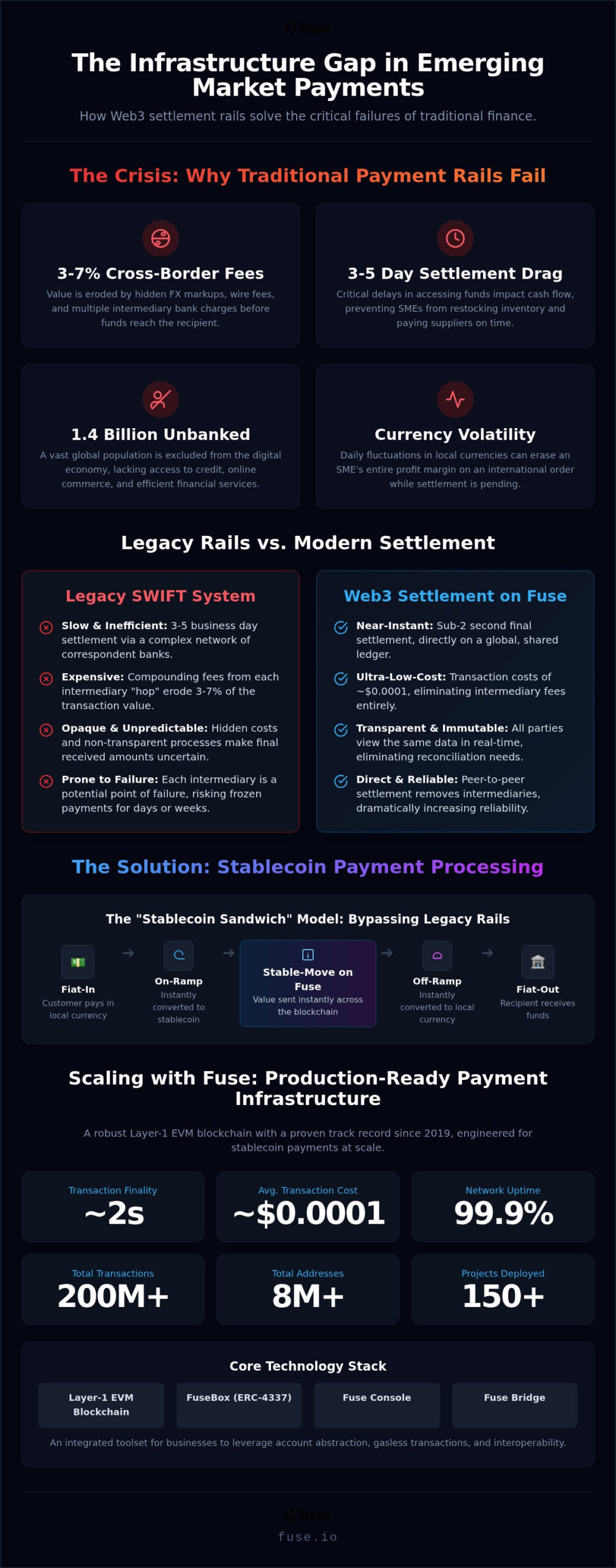
- The Unbanked Barrier: An estimated 1.4 billion adults remain unbanked globally, relying on cash for daily transactions. This reliance excludes them from the digital economy, limiting their access to credit, online commerce, and more efficient financial services.
- The Intermediary Tax: Cross-border payments are burdened by hidden costs. Foreign exchange (FX) markups, wire fees, and intermediary bank charges can erode 3-7% of a transaction’s value before it ever reaches the recipient.
- Settlement Drag: The 3-5 business day settlement period common in traditional banking is a critical bottleneck. For SMEs with tight margins, this delay in accessing funds directly impacts their ability to restock inventory, pay suppliers, and manage cash flow.
- Digital Dollarization: In economies facing high inflation, such as those in parts of Latin America and Africa, citizens and businesses are increasingly seeking refuge in more stable assets. This trend of “Digital Dollarization”—holding and transacting in digital U.S. dollars—is a direct response to the failure of local currencies to preserve value.
The Correspondent Banking Bottleneck
The legacy system for international payments, SWIFT, relies on a network of correspondent banks to move money across borders. This model is inherently inefficient. A single transfer from Nigeria to Singapore might pass through three or four intermediary banks, each one a “hop” in the chain. This system introduces multiple points of friction.
- Layered Fees: Each intermediary bank in the chain takes a fee, compounding the cost of the transaction for the end-user. These fees are often opaque, making it impossible for a business to predict the final amount the recipient will receive.
- Points of Failure: Every hop is a potential point of failure. A compliance flag, a documentation error, or a simple operational delay at any one of the intermediary banks can freeze a payment for days or weeks, with little recourse for the sender.
- Erosion of Trust: For businesses in emerging markets, failed or delayed payments are not just an inconvenience; they damage reputations and can lead to the loss of key international partners.
Currency Volatility and the SME Margin Trap
Operating a business in an environment of high currency volatility is a constant battle. Daily fluctuations of 5-10% are not uncommon in some markets, and such swings can completely erase a week’s worth of profit on an international order. SMEs are caught in a margin trap, forced to price in risk that makes them less competitive on the global stage.
- Profit Erosion: A business might agree to a price for goods in their local currency, only to find that by the time a 3-day SWIFT payment settles, a currency devaluation has wiped out their entire profit margin.
- Restricted USD Access: In many countries with strict capital controls, accessing U.S. dollars for international trade is difficult and expensive. Businesses are often forced to turn to informal markets with unfavorable rates, adding another layer of cost and risk.
- The Limits of Cash: While physical U.S. dollars were once a common hedge, this is no longer a viable or scalable solution for modern digital businesses that need to transact quickly and securely online.
*
Stablecoin Payment Processing for Business: The New Standard
Web3 payment infrastructure offers a direct solution to the failures of traditional rails. By using stablecoins—digital tokens pegged 1:1 to a reserve asset like the U.S. dollar—businesses can bypass the correspondent banking system entirely. This isn’t about speculative cryptocurrency trading; it’s about using blockchain as a superior settlement layer for real-world commerce.
- Beyond Speculation: Stablecoin payment processing treats digital assets like USDC and USDT as programmable, borderless dollars. The focus is on utility and efficiency, not investment.
- The “Stablecoin Sandwich” Model: This practical model allows businesses to operate without holding volatile assets. The flow is simple: Fiat-In (a customer pays in local currency), Stable-Move (the value is instantly converted to a stablecoin and sent across the blockchain), and Fiat-Out (the recipient instantly converts the stablecoin back to their local currency).
- De Facto Digital Dollars: Fully-backed stablecoins like USDC have become the default reserve currencies for internet-native commerce, offering a trusted, transparent, and globally accessible store of value.
- Programmable Money: Using smart contracts, businesses can automate complex payment logic. This includes setting up automated escrow for high-value transactions, instant revenue splits between partners, and royalty payments that execute in real time.
The Mechanics of On-Chain Settlement
A blockchain acts as a global, immutable, and transparent ledger. When a business sends a stablecoin payment, the transaction is broadcast to the network, verified by validators, and permanently recorded on the chain. This process is fundamentally more efficient than the siloed, batch-processed systems used by traditional banks.
- A Shared, Real-Time Ledger: All parties to a transaction can view the same data at the same time, eliminating the need for costly and time-consuming reconciliation processes between different banks’ internal ledgers.
- Authorization vs. Settlement: In traditional finance, authorization (approving the transaction) and settlement (the final transfer of funds) are separate events that can be days apart. In Web3, they happen nearly simultaneously. On a high-performance network like Fuse Network, final settlement occurs in under two seconds.
- 24/7/365 Operations: Blockchain networks do not close for weekends or holidays. This constant availability is transformative for international trade, allowing businesses to send and receive funds whenever they need to, not just during banking hours.
Asset Security and Regulatory Compliance
For institutional adoption, the security of assets and adherence to regulatory standards are non-negotiable. The Web3 ecosystem has matured significantly, providing businesses with the tools to manage digital assets securely and integrate compliance workflows directly into their payment processes.
- Regulated Issuers: Major stablecoins are issued by regulated entities that maintain 1:1 reserves of fiat currency and other liquid assets, audited regularly by third-party firms. This backing provides the foundation of trust for the entire system.
- Non-Custodial Key Management: Modern approaches like account abstraction (ERC-4337) allow businesses to offer non-custodial wallets where users retain full control of their funds without needing to manage complex seed phrases. This can be achieved through familiar social logins or email, abstracting the technical complexity away from the end-user.
- Integrated KYC/AML: Know Your Customer (KYC) and Anti-Money Laundering (AML) checks can be built directly into the payment flow. On- and off-ramps that convert fiat to stablecoins are regulated financial entities that perform these checks, ensuring that businesses can operate in a compliant manner.
The Economic Impact: Reducing FX Markups and Settlement Drag
The theoretical benefits of Web3 payments translate into direct, measurable economic advantages for businesses in emerging markets. By replacing a high-friction, multi-intermediary system with a direct, low-cost settlement layer, stablecoins unlock working capital and create new opportunities for growth.
- Cost Comparison: A $1,000 cross-border transfer via a traditional bank can easily incur $40-$70 in fees (4-7%). The same transfer using USDC on an efficient Layer-1 network costs a fraction of a cent in network fees, plus the minimal cost of on/off-ramping.
- Unlocking Working Capital: Instant settlement eliminates the “working capital drag” caused by waiting for funds. A business that gets paid in seconds instead of days can reinvest that capital immediately, doubling or tripling its inventory turnover rate.
- Case Study in Practice: An export business in Southeast Asia can use stablecoin rails to receive payment from a US buyer. Instead of waiting five days for a SWIFT transfer and losing 5% to fees, they receive the full value in seconds, allowing them to pay their local suppliers the same day and begin work on the next order.
- Enabling Microtransactions: The high base fees of traditional systems make payments under $5 economically unviable. On-chain, transactions costing less than a cent make it possible to build business models around micropayments for content, services, and P2P transfers.
*
Cost Breakdown: SWIFT vs. EVM-Compatible Networks
To understand the scale of the savings, it’s useful to compare the cost structures directly. The SWIFT system involves multiple, often hidden, fees that compound throughout the payment journey.
- Traditional Fees: This stack includes an outgoing wire fee from the sender’s bank, an FX spread (often the largest hidden cost), a fee from one or more intermediary banks, and a receiving fee from the recipient’s bank.
- Web3 Network Costs: On an EVM-compatible Layer-1 network designed for payments, like Fuse, the core transaction cost is the gas fee, which is predictably low. Fuse Network has maintained an average transaction cost of ~$0.0001 for years, even at scale.
- The Compounding Effect: For a merchant processing hundreds of small international payments a month, the savings are not incremental; they are transformative. Reducing transaction costs from several dollars to a fraction of a cent fundamentally changes the economics of their business.
*
Liquidity Velocity and Business Growth
The most underrated benefit of instant settlement is the increase in liquidity velocity. Liquidity Velocity is the speed at which capital cycles through a business. A higher velocity means the same dollar can be used more times over a given period, generating more revenue and growth.
- The Cost of Waiting: “Wait time” is a real cost. A 3-day settlement delay is three days a business cannot use its own money to buy new inventory, pay for marketing, or expand operations. This enforced inefficiency acts as a brake on growth.
- Competitive Advantage: A business that can pay its suppliers instantly can often negotiate better terms. A business that can access its sales revenue immediately can outmaneuver slower competitors by restocking popular products faster.
Building for the Mobile-First User: Solving Onboarding and Gas Friction
For Web3 payments to achieve mass adoption in emerging markets, the technology must become invisible. The end-user experience needs to match—and exceed—the simplicity of the best Web2 mobile apps. This requires solving the two biggest historical barriers to entry: complex onboarding and unpredictable transaction fees (gas).
- The UX Gap: Traditional crypto wallets, with their emphasis on seed phrases and technical jargon, are not suitable for the average consumer or small business owner. The onboarding process must be intuitive and familiar.
- Abstracting Complexity: The unique thesis for scaling Web3 in these markets is that the blockchain must be completely abstracted. The user should feel like they are using a seamless payment app, without needing to know they are interacting with a decentralized network.
- Solving the Gas Problem: Forcing users to acquire and hold a network’s native token just to pay for transaction fees is a critical point of failure. The solution is sponsored, or “gasless,” transactions.
- Embedded Wallets: The most effective approach is to embed non-custodial wallet functionality directly into existing mobile applications, allowing businesses to add Web3 payment rails without forcing their users to download a separate app.
Solving the Gas Fee Problem with Account Abstraction
The key technology enabling a seamless user experience is Account Abstraction (ERC-4337). This Ethereum standard decouples the wallet from the private key, turning user accounts into programmable smart contracts. This allows for far more flexible and user-friendly designs.
- Sponsored Transactions: With account abstraction, a business can use a “Paymaster” contract to sponsor gas fees on behalf of its users. The user simply clicks “send,” and the transaction is processed without them needing to hold or even be aware of the network’s native FUSE token.
- The Psychology of “Free”: In markets where every cent counts, offering a transaction experience that feels free is a powerful driver of adoption and retention. This is precisely what projects building on Fuse, like the Freedom Wallet in South Africa, have leveraged to scale their user base.
Non-Custodial Onboarding via Social Logins
Account abstraction also revolutionizes the onboarding process. It eliminates the need for users to write down and securely store a 12-word seed phrase—a major source of anxiety and a common reason for user drop-off.
- Familiar Web2 Logins: Developers can now create non-custodial wallets that users can access with their existing Google, Facebook, or email accounts. This provides a familiar, low-friction entry point while preserving the core Web3 principle of self-custody.
- Balancing Control and Usability: This model offers the best of both worlds. The user remains the sole owner of their assets, but the access and recovery mechanisms are intuitive. They get the security of a non-custodial wallet with the user experience of a standard mobile app.
- Simplified Integration: Toolkits like FuseBox provide developers with the necessary APIs and SDKs to implement account abstraction, including social logins and gasless transactions, directly into their mobile applications.
Scaling with Fuse: The Infrastructure for Last-Mile Web3 Payments
Fuse provides the production-ready infrastructure for businesses and developers building the next generation of payment solutions for emerging markets. Live since 2019, the Fuse Network is a battle-tested Layer-1 blockchain specifically engineered for the demands of high-volume, low-cost mobile payments.
- Performance-Built for Payments: Fuse is an EVM-compatible Layer-1 delivering sub-2 second finality and an average transaction cost of ~$0.0001. With a track record of over 200 million transactions and 99.9% uptime, it provides the reliability required for enterprise-grade applications.
- FuseBox: The Account Abstraction Toolkit: FuseBox is the ERC-4337 infrastructure stack that enables developers to build user-friendly applications with gasless transactions and social logins, making the blockchain invisible to the end-user.
- Fuse Console: A dedicated dashboard for developers and businesses to easily deploy and manage smart contracts, monitor application performance, and access network services.
- Network Security and Interoperability: The network is secured by a decentralized set of validators through FUSE token staking. The Fuse Bridge ensures seamless asset transfer between Fuse and other major blockchain ecosystems.
Why EVM Compatibility Matters for Global Scaling
Fuse’s compatibility with the Ethereum Virtual Machine (EVM) is a critical strategic advantage. It allows Fuse to benefit from the largest and most secure blockchain ecosystem in the world while offering a far more scalable and cost-effective environment.
- Access to a Mature Ecosystem: Developers can use the same battle-tested tools, programming languages (like Solidity), and code libraries from the Ethereum ecosystem, dramatically reducing the development learning curve.
- Easy Migration: Projects that build on more expensive EVM-compatible chains can easily migrate their applications to Fuse to take advantage of its low, stable transaction fees without needing to rewrite their smart contracts.
- Native Stablecoin Support: Fuse’s EVM compatibility ensures seamless interoperability with major stablecoins like USDC and USDT, which are essential for any serious payment application.
Getting Started: From Idea to Deployment
Launching a Web3 payment solution on Fuse is a straightforward process designed for professional teams. The ecosystem provides the tools, support, and infrastructure needed to move from concept to a production-ready application efficiently.
- Step 1: Architect Your Solution: Use the extensive documentation on docs.fuse.io to design your payment flow, leveraging FuseBox for a superior user experience.
- Step 2: Deploy and Manage: Use the Fuse Console to deploy your smart contracts to the network and manage your project’s on-chain components.
- Step 3: Scale Your Business: Access the Ignite program for potential funding and tap into an ecosystem of over 150 integrated projects and partners to accelerate your growth.
- CTA: Launch your Web3 payment solution on Fuse today.